<p class="wp-block-paragraph"><strong>At Harvard, the most exclusive university in America, something strange has happened. Excellence has become… ordinary.</strong></p>


<p class="wp-block-paragraph">For years, Harvard has been handing out A’s like Halloween candy. Now, in a rare moment of institutional self-awareness, the school is considering taking the candy bowl away. Predictably, students are not pleased. And by “not pleased,” we mean they are howling.</p>


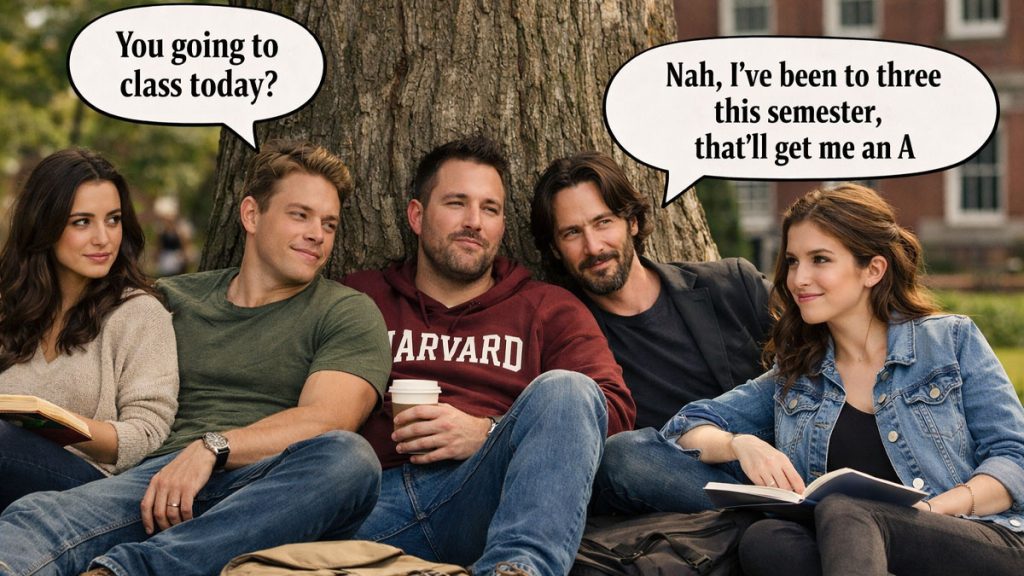
<p class="wp-block-paragraph">Let’s start with the numbers, because they tell a story that is almost too absurd to believe. Harvard’s own internal report found that about 60% of grades were A’s in the 2024–25 school year, up from roughly 25% in 2005–06. In less than two decades, Harvard went from a place where A’s meant something to a place where they are the default setting.</p>


<figure class="wp-block-image size-large"><img src="https://nakedpolitics.net/wp-content/uploads/2026/04/gradeharvarddgh-1024x576.jpg" alt="" class="wp-image-7179"/></figure>


<p class="wp-block-paragraph">The median GPA now sits at a lofty 3.83, which is less a measure of distinction and more a sign that nearly everyone is clustered at the top. Even Harvard itself admitted the obvious: the current system is “failing to perform the key functions of grading” and is “damaging the academic culture of the College more generally.” That is a polite academic way of saying the system is broken.</p>


<h2 class="wp-block-heading"><strong>Harvard’s Modest Proposal: Maybe Not Everyone Gets an A</strong></h2>


<p class="wp-block-paragraph">Faced with this academic sugar rush, Harvard faculty are now considering a radical idea: limit A’s. The proposal would cap A grades at 20% per course, with a small allowance for variation in smaller classes. In other words, A’s would once again mean what they are supposed to mean: exceptional performance.</p>


<p class="wp-block-paragraph">The plan also suggests eliminating GPA as an internal metric and replacing it with percentile rankings for honors. That alone tells you how distorted things have become. When nearly everyone has a near-perfect GPA, the number itself becomes useless. As one professor put it, the goal is to restore meaning and distinction. Right now, “you can’t tell who’s actually the best in the class.”</p>


<h2 class="wp-block-heading"><strong>The Outrage: Students Discover Competition</strong></h2>


<p class="wp-block-paragraph">If you thought Harvard students would welcome a return to rigor, think again. A survey found that 94% of students oppose the cap. That is not a debate. That is a near-unanimous revolt.</p>


<p class="wp-block-paragraph">Students have called the proposal “crude” and “absurd,” with one complaining that pushing it forward despite overwhelming opposition shows “how much this administration cares about us.” Others warn that limiting A’s will increase stress and competition, as if Harvard were previously known for its relaxed, pressure-free environment. One student reportedly cried “the whole entire day” over the proposal.</p>


<p class="wp-block-paragraph">Beneath the outrage lies a deeper truth. Harvard students have grown accustomed to a system where top grades are common and failure is rare. When A’s dominate the transcript, anything less begins to feel like failure. Even Harvard’s own administrators admit that “anything less is stigmatized.”</p>


<p class="wp-block-paragraph">This creates a strange paradox. Students are surrounded by success, yet constantly anxious about slipping below perfection. Now, faced with the possibility that they might actually have to compete again, many are pushing back hard.</p>


<h2 class="wp-block-heading"><strong>What the Research Says About Easy A’s</strong></h2>


<p class="wp-block-paragraph">This is not just a Harvard problem. It is a national trend. Grades across American education have been rising for decades, but the research suggests this comes at a cost.</p>


<p class="wp-block-paragraph">Grades are supposed to be the “fundamental currency” of education, signaling ability and effort. When too many A’s are handed out, that signal breaks down and loses its meaning. In plain English, if everyone gets an A, the A stops meaning anything.</p>


<p class="wp-block-paragraph">A 2026 study, “Easy A’s, Less Pay,” found that students exposed to lenient grading had lower future test scores, were less likely to graduate or attend college, and ultimately earned less later in life. The researchers described a “causal chain” where easy grades lead to less effort, weaker skills, and long-term consequences.</p>


<h2 class="wp-block-heading"><strong>The False Confidence Problem</strong></h2>


<p class="wp-block-paragraph">There is another, more subtle danger. Grade inflation gives students a false sense of their own abilities. If you earn top marks without mastering the material, you believe you are excelling when you are not. That illusion holds until reality intervenes, often in graduate school or the workforce.</p>


<p class="wp-block-paragraph">Even top-performing students are affected. When everyone receives high grades, legitimate achievement is diluted and thrown into doubt. The signal disappears, and with it, the ability to distinguish real excellence.</p>


<h2 class="wp-block-heading"><strong>The Quiet Decline in Learning</strong></h2>


<p class="wp-block-paragraph">Perhaps the most troubling finding is that more A’s do not mean more learning. Harvard’s own data shows that study time has barely changed in nearly two decades, even as grades have soared.</p>


<p class="wp-block-paragraph">At the same time, broader research shows that student achievement has stagnated or declined even as grades rise. Some professors are seeing it firsthand. One noted that students now score lower on the same exams he has used for years.</p>


<p class="wp-block-paragraph">The conclusion is hard to avoid. Students are not necessarily learning more. They are simply being graded more generously. When students realize they can earn top marks without fully mastering the material, the incentive to push harder quietly disappears.</p>


<h2 class="wp-block-heading"><strong>Why This Keeps Happening</strong></h2>


<p class="wp-block-paragraph">Grade inflation persists because it benefits everyone in the short term. Students are happier with higher grades, professors receive better evaluations, and universities attract more applicants.</p>


<p class="wp-block-paragraph">As one professor admitted, “Everyone has an incentive to keep inflating grades unless everyone else stops simultaneously.” That is the trap. No one wants to be the first to restore standards, because doing so makes them less attractive compared to easier alternatives.</p>


<h2 class="wp-block-heading"><strong>Back to Reality, One A at a Time</strong></h2>


<p class="wp-block-paragraph">Harvard’s proposal to cap A’s is, in reality, a modest attempt to restore sanity. Even supporters call it “the mildest measure imaginable.” It does not eliminate A’s. It simply makes them meaningful again.</p>


<p class="wp-block-paragraph">Yet the backlash reveals how deeply the culture of inflated grades has taken hold. Students who once competed fiercely to get into Harvard now seem less enthusiastic about competing once they are there.</p>


<p class="wp-block-paragraph">This debate is about more than grades. It is about what a Harvard degree represents. If A’s are handed out to the majority of students, then excellence becomes indistinguishable from adequacy. Over time, that erodes trust in the institution itself.</p>


<p class="wp-block-paragraph">Employers and graduate schools are forced to look elsewhere for signals of ability, because grades alone no longer tell the story. Harvard’s administrators seem to understand this. As one put it, the university has a duty to “preserve the reputation of Harvard.” That reputation was built on rigor, not generosity.</p>


<h2 class="wp-block-heading"><strong>Final Thought: The End of Easy A’s</strong></h2>


<p class="wp-block-paragraph">For over a century, critics have warned about grade inflation. As far back as 1894, Harvard itself noted that A’s were sometimes given “too readily.”</p>


<p class="wp-block-paragraph">Now, more than a hundred years later, the problem has reached a point where nearly everyone is at the top. Harvard is finally trying to fix it.</p>


<p class="wp-block-paragraph">The only question is whether its students are ready for a world where an A actually has to be earned—or whether they would rather keep the candy coming.</p>


<p class="wp-block-paragraph"><strong>NP Editor: </strong> Now we know the source of the &#8220;participation trophy.&#8221; Students from Harvard value short term happiness over hard work, intense learning and an elite education. &#8220;Woke&#8221; strikes again.</p>


<p class="wp-block-paragraph">The only reason to send your kid to Harvard is to meet other rich kids. Since the education is no longer that good, there really isn&#8217;t any other reason&#8230;</p>

Harvard’s A-for-All Era: When Excellence Becomes Merely Participation