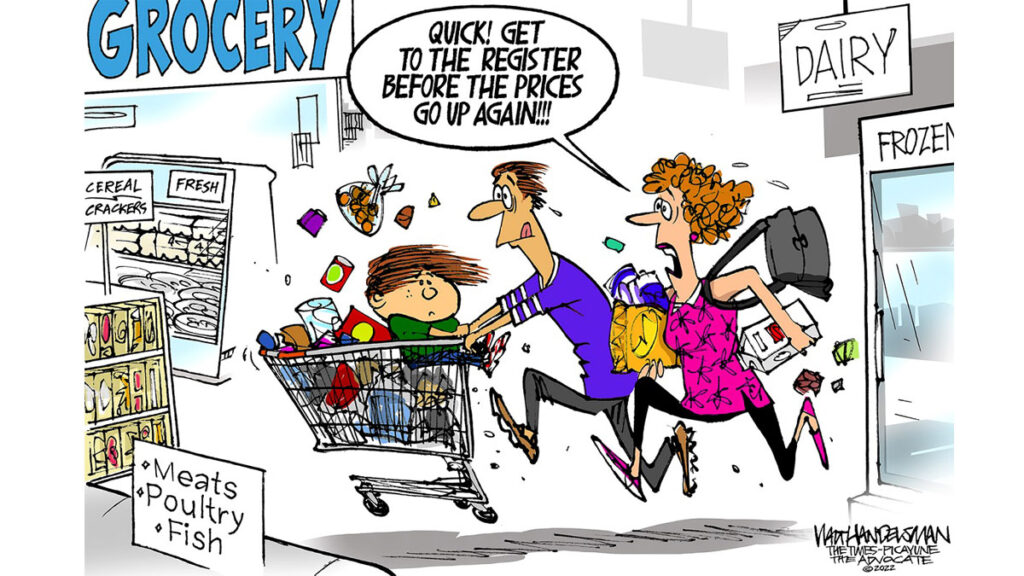
<p class="wp-block-paragraph">According to government statistics, the rate of inflation is coming down. ; ; You can either believe that or believe what you see happening to your family expenses.</p>


<p class="wp-block-paragraph">First and foremost, we should remember that a reduction in the RATE of inflation is NOT a reduction in prices. They are still going up &#8230; up &#8230; and up. Just not at the super high rate of the past. And all whose increased prices from past inflation are the floor for the new price increases. In other words, the impact of the past high inflation is still baked into the prices you pay at the store. In other words, a 3 percent increase today is a greater dollar increase than a 3 percent increase four years ago, when the base price was much lower.</p>


<p class="wp-block-paragraph">It would be bad news even if the government figures were accurate in terms of the family budget. ; However, anyone who pays the family bills or does the shopping knows that the family’s increased costs significantly exceeded the government’s announced inflation rate – often more than double in some cases.</p>


<p class="wp-block-paragraph">Just as an example, I went to buy some avocados. The price was 70 percent over last year’s price. Same with eggs. In fact, it was almost impossible to find any item that only rose at the government-announced inflation rate. While President Biden talks about 7 percent inflation at the high point, economists know that food prices for the average family rose more than 20 percent.</p>


<p class="wp-block-paragraph">The next shock to the public – especially those on Medicare with private advantage programs – will be in the form of copays. United Healthcare is raising the copays on medical services (not drugs) across the board – often as much as 70 percent. In addition, they reduced the quarterly over-the-counter benefit from $40 dollars to $25, dropped the rewards programs and ended Golden Sneakers gym memberships.</p>


<p class="wp-block-paragraph">For those on Social Security, at least there is the so-called Cost of Living Adjustment (COLA). ; It is a misnomer. ; Never does the cost of living adjustment match the actual increase in the real cost of living.</p>


<p class="wp-block-paragraph">While they say inflation is dropping below 3 percent, the family budget is still experiencing price increases in excess of the official government statistics. ; ; It looks good on paper, since the COLA increase is about 2 percent for 2025, and the official inflation rate is 2.5 percent. ; Unfortunately, the family budget will be hit with cost increases in 2025 in the neighborhood of 6 percent.</p>


<p class="wp-block-paragraph">This year – because of the government’s version of reduced inflation – the increase in the average monthly Social Security – the COLA &#8212; will be a whopping $48. ; Not even enough to take a kid to a baseball game.</p>


<p class="wp-block-paragraph">Fans of Social Security say that the COLA is destined to prevent retirees from losing purchasing power in the face of inflation. In reality, retirees lose purchasing power every year despite COLA increases because they do not match the actual cost increases.</p>


<p class="wp-block-paragraph">Millions of Americans rely on Social Security as an important part of their financial security. ; However, that does not make Social Security a good investment. ; In fact, it is a terrible investment. ; In terms of purchasing power, it has a negative return on investment. ; ; The money you get from Social Security is worth less than the money people put in. ; ; In other words, it is a losing investment.</p>


<p class="wp-block-paragraph">Those who are currently struggling to stay afloat will continue to struggle to stay afloat – maybe more so as their credit cards get max-ed out. ; That is another looming economic disaster rolling through the country without much attention being paid by the supposedly smart folks in Washington.</p>


<p class="wp-block-paragraph">So, there ‘tis.</p>

Forget the official stats. Inflation is raging in the family budget