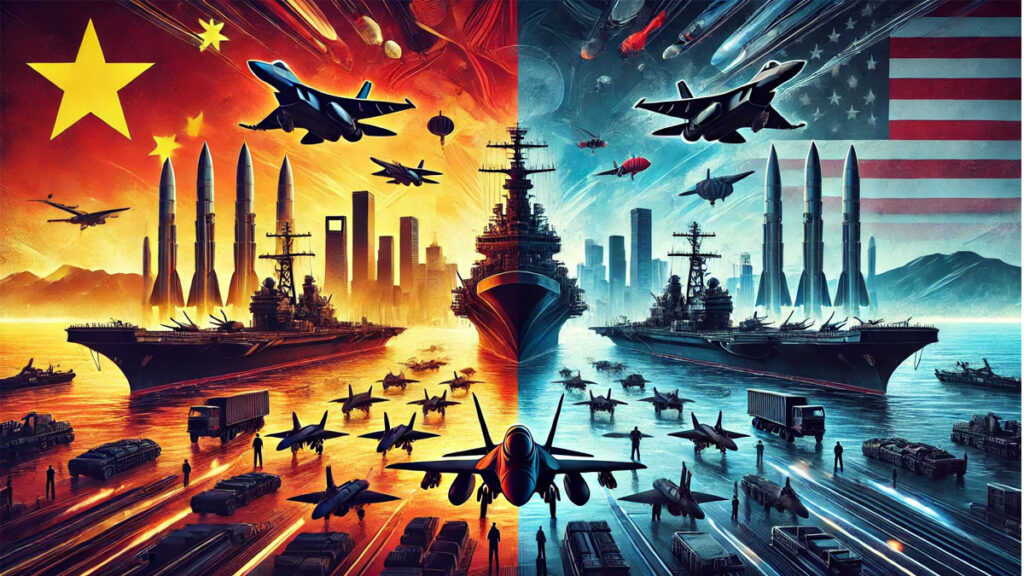
<p class="wp-block-paragraph">In recent years, the world has witnessed China ramp up its military power at an unprecedented pace, positioning itself as a serious threat to the balance of global power. In his eye-opening article for <em>Foreign Affairs</em>, “China Is Ready for War And Thanks to a Crumbling Defense Industrial Base, America Is Not,” Seth G. Jones reveals just how prepared China is for conflict—and how shockingly underprepared the United States appears in comparison. The growing disparity between China’s military capabilities and those of the U.S. raises critical questions about global security, the readiness of America&#8217;s defense systems, and what can be done to bridge this worrying gap.</p>


<p class="wp-block-paragraph">Jones makes it clear that while much of the policy debate in Washington has focused on containing China’s economic and technological influence, the real story is China&#8217;s military expansion. Despite economic challenges like high youth unemployment, a troubled real estate market, and an aging population, China is doubling down on military spending and developing weapons systems at a speed that the United States has not matched in decades. To keep up with this rapid expansion, the United States must undergo major reforms—both in mindset and practice—if it is to ensure that it is not left behind.</p>


<h3 class="wp-block-heading" id="h-china-s-strategic-military-build-up-a-wartime-footing"><strong>China’s Strategic Military Build-Up: A Wartime Footing</strong></h3>


<p class="wp-block-paragraph">Chinese President Xi Jinping has been vocal about his ambition to make China a world-class military power, seeing it as central to the &#8220;great rejuvenation of the Chinese nation.&#8221; This goal isn’t just about having a large army; it’s about ensuring that the nation has the military hardware, technology, and systems to support the People’s Liberation Army (PLA) in becoming one of the most formidable fighting forces in the world.</p>


<p class="wp-block-paragraph">In his article, Jones emphasizes that &#8220;China has already caught up to the United States in its ability to produce weapons at mass and scale,&#8221; which means China can create everything from ships to missiles in quantities that rival or exceed American output. He adds, &#8220;In some areas, China now leads: it has become the world’s largest shipbuilder by far, with a capacity roughly 230 times as large as that of the United States.&#8221; This vast production capacity allows China to churn out warships, fighter jets, and missiles at a rate that outpaces the United States by five to six times.</p>


<p class="wp-block-paragraph">From 2021 to early 2024 alone, China’s defense industry produced over 400 modern fighter aircraft, 20 large warships, and even a new stealth bomber. During the same period, China doubled its inventory of ballistic and cruise missiles, as well as its nuclear warhead count, and launched 50% more satellites than before. All of this positions China as a military heavyweight capable of challenging U.S. influence, especially in the Indo-Pacific region, where strategic competition is intensifying.</p>


<p class="wp-block-paragraph">The backbone of this massive expansion is China&#8217;s network of state-owned enterprises, many of which have now become global giants in both defense and non-defense sectors. Jones highlights this shift, stating that &#8220;Today, four of the world’s top ten largest companies in combined defense and nondefense revenue are Chinese,&#8221; which is a seismic change from just ten years ago when no Chinese company made the top 100 list. Now, Chinese defense companies, like Aviation Industry Corporation of China and China State Shipbuilding, are in the top ranks alongside American titans like Lockheed Martin and Raytheon.</p>


<p class="wp-block-paragraph">These state-owned enterprises have enabled China to make swift advancements in cutting-edge technologies. They’ve improved their research and development pipelines and acquisition processes, allowing the PLA to develop advanced platforms in areas like hypersonics, carrier-based aviation, and cyber capabilities. These improvements allow China to modernize its military much more efficiently and effectively, supporting its long-term strategy of becoming the dominant military force in the region.</p>


<h3 class="wp-block-heading" id="h-naval-dominance-a-clear-example-of-china-s-supremacy"><strong>Naval Dominance: A Clear Example of China’s Supremacy</strong></h3>


<p class="wp-block-paragraph">Perhaps the clearest manifestation of China&#8217;s military ambitions is the rapid growth of its naval forces. The PLA Navy now has more vessels than any other navy in the world, thanks largely to China’s massive shipbuilding industry. Jones points out, &#8220;The U.S. Navy estimates that a single Chinese shipyard—such as the one on Changxing Island, located along China’s eastern coast—has more capacity than all U.S. shipyards combined.&#8221; This staggering statistic highlights just how far ahead China is in terms of shipbuilding.</p>


<p class="wp-block-paragraph">The growth of China’s navy includes not just quantity but quality as well. In the past decade, China’s shipyards have produced modern corvettes, advanced destroyers, and even aircraft carriers like the Shandong and Fujian. The Fujian, in particular, features an electromagnetic catapult launch system that enhances its capabilities for air operations, making it far more sophisticated than previous models. It can deploy up to 70 aircraft, including fighter jets and antisubmarine helicopters, allowing the PLA Navy to project power across a wider area.</p>


<p class="wp-block-paragraph">Although the U.S. Navy still holds certain advantages, such as a greater capacity for missile firepower and more advanced nuclear-powered submarines, China’s shipbuilding output gives it a crucial edge in any potential protracted conflict. Many of China’s shipyards are used for both commercial and military construction, meaning that China can readily increase its production of military vessels if tensions escalate—a flexibility that the U.S. lacks due to its much smaller shipbuilding infrastructure.</p>


<h3 class="wp-block-heading" id="h-air-and-missile-capabilities-a-fast-growing-threat"><strong>Air and Missile Capabilities: A Fast-Growing Threat</strong></h3>


<p class="wp-block-paragraph">In addition to its naval power, China has made tremendous progress in air power and missile development. The Aviation Industry Corporation of China, China’s largest military aircraft producer, is behind much of this growth. The company runs 86 laboratories and research centers, employs thousands of people, and produced more than 2,000 fourth- and fifth-generation combat aircraft in 2023 alone—more than double the 800 manufactured in 2017. The United States, while still ahead with more than 3,350 fourth- and fifth-generation fighters in 2023, is facing growing pressure as China rapidly narrows the gap.</p>


<p class="wp-block-paragraph">China has also made significant advancements in its missile arsenal. It has rapidly expanded its capacity to produce ballistic, cruise, and hypersonic missiles, all of which pose a serious threat to U.S. assets in the region. &#8220;In 2021 alone, China launched more ballistic missiles for testing and training than all other countries combined,&#8221; Jones states, highlighting the urgency of the threat. China’s hypersonic glide vehicle, the DF-17, is capable of striking U.S. and allied bases in the western Pacific—a technology that the United States has struggled to keep pace with.</p>


<p class="wp-block-paragraph">Moreover, China’s space capabilities have also expanded significantly, with 67 launches in 2023 alone. The PLA has enhanced its global satellite navigation system, improved missile warning systems, and developed technologies for countering an adversary’s space capabilities. These advances give China a major advantage in intelligence, surveillance, and reconnaissance, as well as in disrupting an enemy’s communication networks, all of which would be crucial in a potential conflict.</p>


<h3 class="wp-block-heading" id="h-the-u-s-defense-industry-challenges-and-bottlenecks"><strong>The U.S. Defense Industry: Challenges and Bottlenecks</strong></h3>


<p class="wp-block-paragraph">While China’s defense industry grows, the United States finds itself struggling to adapt to the realities of a potential great-power conflict. The U.S. defense industrial base has faced years of underinvestment, and its contracting system is outdated and ill-suited to the demands of wartime. Jones notes that &#8220;Major defense programs continue to take ten years or more to deliver less capability than planned, often at two to three times the planned cost.&#8221; This inefficiency has left the U.S. unable to produce enough munitions and equipment to fight a protracted war, particularly in the Indo-Pacific region, where tensions with China are most likely to escalate.</p>


<p class="wp-block-paragraph">One major weakness of the U.S. defense sector is its supply chains, which are fragile and vulnerable to disruption. Many critical components, such as advanced batteries and raw materials used in defense manufacturing, are controlled by China. If tensions were to escalate, China could cut off access to these resources, significantly hampering U.S. production capabilities. Labor shortages further compound these problems. Shipyards across the country lack the skilled workers needed to complete critical naval projects. For instance, the construction of new guided-missile frigates and Virginia-class submarines is currently years behind schedule due to a lack of welders, pipefitters, and other key tradespeople.</p>


<h3 class="wp-block-heading" id="h-bridging-the-gap-what-the-u-s-must-do-to-prepare"><strong>Bridging the Gap: What the U.S. Must Do to Prepare</strong></h3>


<p class="wp-block-paragraph">To counter China’s growing capabilities, the United States must take decisive action to revitalize its defense industrial base. The first step is acknowledging the urgency of the problem and taking comprehensive measures to address it. Jones suggests that a presidential initiative similar to Franklin Roosevelt’s War Production Board during World War II could help marshal resources and set priorities for defense production. This new initiative could oversee procurement and production, while also integrating efforts across various federal agencies, Congress, and the private sector.</p>


<p class="wp-block-paragraph">Additionally, the U.S. needs to reform its contracting and acquisition processes. As it stands, the system is too slow and risk-averse, which prevents the military from quickly acquiring and fielding new technologies. Streamlining the timeline for contracts, investing in companies with innovative solutions, and funding multiyear procurement for critical munitions would help the U.S. defense industry catch up to China’s rapid production pace.</p>


<p class="wp-block-paragraph">The workforce is another area that requires significant attention. The Pentagon must incentivize defense companies to train and reskill workers and should invest in vocational schools, universities, and other educational programs that prepare people for jobs in defense manufacturing. Addressing these labor shortages is critical for closing the gap between the United States and China in shipbuilding and other defense production sectors.</p>


<p class="wp-block-paragraph">Revitalizing the shipbuilding industry is also crucial. Bringing back subsidies for shipyards, which have long been dormant, would help modernize the industry, boost production capacity, and develop a more competitive workforce. Without these changes, the U.S. will continue to fall behind in naval capabilities, which are vital for maintaining influence and stability in the Indo-Pacific.</p>


<h3 class="wp-block-heading" id="h-a-call-for-a-new-arsenal-of-democracy"><strong>A Call for a New Arsenal of Democracy</strong></h3>


<p class="wp-block-paragraph">In 1940, a year before the Japanese attack on Pearl Harbor, President Roosevelt called on Americans to build every machine and every factory necessary to secure the nation&#8217;s defense. Today, as China’s military buildup continues unabated and as wars rage on in other parts of the world, the U.S. must heed this call once again. As Jones writes, “China is preparing for a war and specifically for a war with the United States.” The question now is whether the United States will rise to the challenge and take the steps needed to protect itself and its allies.</p>


<p class="wp-block-paragraph">ACZ Editor: We believe that the military of the U.S. with its technology, experience and size is still an unbeatable force in almost every situation in any location on earth. But China has made great strides in production, so the question becomes &#8220;Can we beat China with our superior force but with a five to one disadvantage?&#8221; How about a ten to one advantage? Or twenty? And our technology lead will gradually wane, given that they have stolen a great deal of our technology and have focused their own brain power on military pursuits.</p>


<p class="wp-block-paragraph">This is worrisome.</p>

Foreign Affairs: China is Ready for War, We are Not