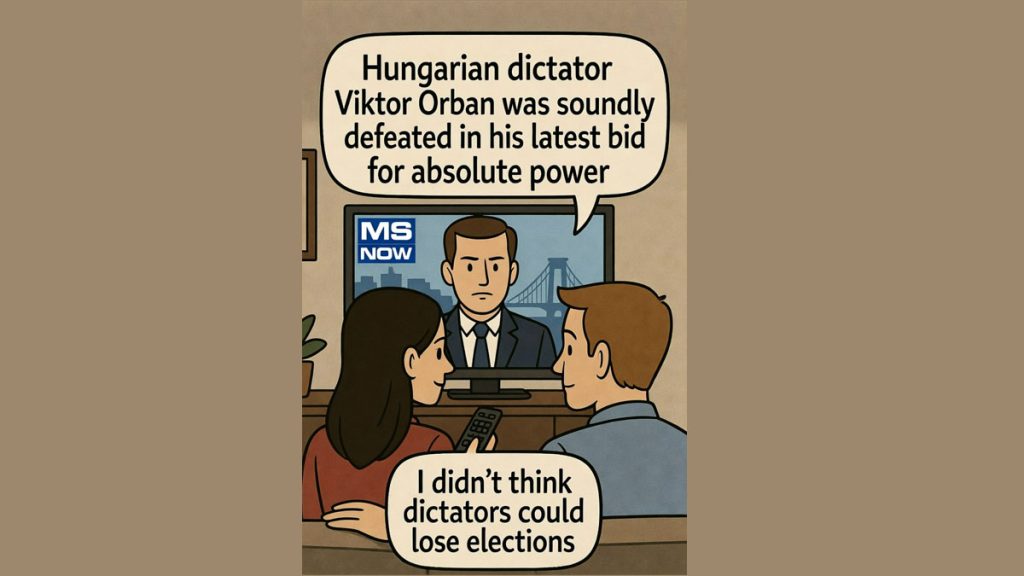
<p class="wp-block-paragraph">Calling someone a dictator does not make it so. President Trump is not a dictator – nor is Hungarian Prime Minister Viktor Orbán. Yet the left-wing Democrats and their media cronies keep slinging the term around as if repeating a lie often enough turns it into truth. It does not. Both men rose to power through the ballot box, not through coups or power grabs. Both have faced the checks and balances of democratic institutions. And both have left office after an electoral defeat without resorting to force. (Just to keep the record straight, Trump’s first term ended on January 20, 2021. He left office peacefully.) That is not the record of dictators.</p>


<p class="wp-block-paragraph">The claims of dictatorship against Trump are an extension of the Democrats other false political narrative – that the riot that broke out on Capitol Hill on January 6 was an insurrection.</p>


<p class="wp-block-paragraph">Trump is the duly and constitutionally elected President of the United States. He did not seize the office. He won it fair and square after spending four years out of power – a fact that alone demolishes any dictator nonsense. Dictators do not voluntarily leave office and then win it back at the ballot box. They cling to power until dragged out by war, coup, or revolution.</p>


<p class="wp-block-paragraph">To be sure, Trump has tested the boundaries of presidential authority more aggressively than most. That is not the same as exceeding them unlawfully. Every president pushes the envelope from time to time. The Constitution provides the remedy. The Supreme Court ultimately decides when a president has gone too far. That is exactly how the system is supposed to work. It is called separation of powers, not dictatorship.</p>


<p class="wp-block-paragraph">Past presidents learned this lesson the hard way. President Harry Truman saw his dramatic seizure of the nation’s steel mills during the Korean War struck down by the Supreme Court in the landmark Youngstown Sheet &; Tube case. The justices ruled that the president lacked the authority to take such action without congressional approval. President Franklin Roosevelt watched key elements of his New Deal agenda collapse under Supreme Court scrutiny, including the National Industrial Recovery Act in <em>Schechter Poultry Corporation v. United States</em>. Even President Richard Nixon had to surrender his White House tapes after the Supreme Court rejected his claims of absolute executive privilege in <em>United States v. Nixon.</em> These were not acts of defiance. They were presidents operating within a constitutional framework that ultimately checked their power. Trump has done the same.</p>


<p class="wp-block-paragraph">Some lower federal courts have ruled against Trump on various policies. Those are not final decisions. They are opinions subject to higher review. And time after time, the Supreme Court has overturned those lower court rulings in the President’s favor. The travel ban provides a classic example. Multiple lower courts blocked it, only for the Supreme Court to uphold the policy in <em>Trump v. Hawaii</em>. In more recent cases involving the current administration, the high court has stepped in repeatedly to stay lower court injunctions that sought to hamstring executive actions on federal grants, immigration enforcement, and agency reforms. The justices have limited the abuse of nationwide injunctions by single district judges – another major victory for the administration and for constitutional order.</p>


<p class="wp-block-paragraph">Trump has lost a couple of decisions at the Supreme Court. The Court ruled against his use of certain emergency powers to impose broad tariffs under the International Emergency Economic Powers Act. The justices also blocked an attempt to federalize the National Guard in Illinois in a specific dispute. Yet in both instances,</p>


<p class="wp-block-paragraph">Trump accepted the rulings without resistance. He did not defy the Court. He did not threaten the justices. He did not hold the nation hostage until he got his way. That is not the behavior of a dictator. That is the conduct of a leader who respects the rule of law even when it does not go his way. Dictators do not lose court cases and move on. They eliminate the courts or pack them with loyalists who never say no.</p>


<p class="wp-block-paragraph"><strong>Viktor Orbán</strong></p>


<p class="wp-block-paragraph">As a disclaimer, I have never been a fan of Orban based on his policies. I am glad he has been defeated, but &#8230; he is no dictator and Hungary is still a functioning democracy.</p>


<p class="wp-block-paragraph">The standard that applies to Trump also applies to Orbán. Left-wing Democrats and their media cronies have labeled Orbán a dictator for years. Orban has been a more powerful leader in Hungary than his predecessors since the fall of the Soviet Union &#8212; and the liberation of captive nations like Hungary. Orbán’s actions that many Americans find most egregious (including me) – such as rewriting the constitution to consolidate power, exercising greater control over the judiciary and media and his closeness to Russia’s Vladimir Putin – seem to have had the approval of the Hungarian people, who elected him multiple times with strong mandates.</p>


<p class="wp-block-paragraph">There is no better refutation of the left’s false claim – essentially political name-calling – that Orban is a real dictator than the fact that he lost his recent reelection bid by a wide margin. With the results rolling in, Orban conceded defeat. <strong>Dictators do not lose elections.</strong> They rig them or cancel them.</p>


<p class="wp-block-paragraph">Orbán’s opponent, Péter Magyar, won in a landslide with 54 percent of the vote to Orbán’s 38 percent. Magyar’s party captured 138 seats in parliament compared to Orbán’s 55. The democratic process is alive and well in Budapest. The people spoke. The leader stepped aside. That is democracy, not dictatorship.</p>


<p class="wp-block-paragraph">It is no small irony that the Democratic Party – which believes in a strong central regulatory government run by an elite corps of bureaucrats – is the one throwing out the dictator accusations against conservatives who believe in limited government. Democrats love big government that they control. They cheer when federal judges issue nationwide injunctions to stop conservative policies. They howl when the Supreme Court reins in the administrative state or upholds executive authority under the Constitution. Yet when conservatives win elections and govern according to their mandate, the left screams “dictator.”</p>


<p class="wp-block-paragraph">The truth is simpler. Trump and Orbán are not dictators. They are elected leaders who challenge the left’s vision of endless government expansion, open borders, and cultural transformation. That challenge makes them dangerous in the eyes of the elite. So, the left reaches for the most inflammatory label available: dictator. It is a rhetorical trick, not a factual description.</p>


<p class="wp-block-paragraph">The American people and the Hungarian people have shown they can tell the difference. They elect these men because they deliver results – stronger borders, economic growth, traditional values, and resistance to globalist overreach. When the voters change their minds, as they did in Hungary, the leaders accept it. No tanks roll in the streets. No opposition figures disappear. No elections are annulled.</p>


<p class="wp-block-paragraph">Calling someone a dictator does not make it so. Evidence does. And the evidence shows that neither Trump nor Orbán fall into that category. They are strong leaders, but still the products of democracy, accountable to voters and constrained by courts.</p>


<p class="wp-block-paragraph">The real threat to liberty comes not from these leaders but from those who would weaponize language, courts, and media to silence opposition and centralize power in the hands of unelected elites. The left should look in the mirror before hurling insults. The dictators they fear are not the ones winning elections and respecting the Constitution. They are the ones who cannot stand the idea that people might disagree with them.</p>


<p class="wp-block-paragraph">So, there ‘tis.</p>

Enough of the Left’s Dictator BS