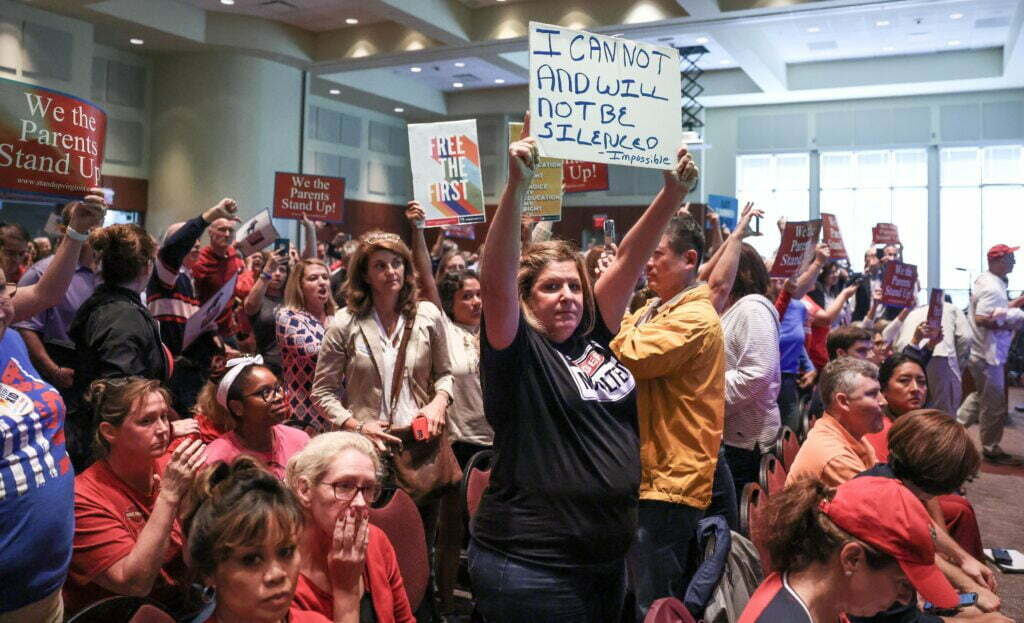
<p class="wp-block-paragraph">United States Attorney General Merrick Garland issued a directive to the FBI to monitor school board meetings to address what is said to be an increasing level of intimidation and violence against educators and administrators.</p>


<p class="wp-block-paragraph">Garland said in his letter that it is not the Department of Justice’s intent to stifle “spirited debate.” ; There are two problems with the AG’s order.</p>


<p class="wp-block-paragraph">First, I know of no precise legal definition of “spirited debate.” ; As a spokesperson for both the Chicago and Detroit Boards of Education during intense union negotiations and teacher strikes, I have faced crowds of angry parents – the kind of yelling fist-shaking folks you see in the current television reports. ; I never had the back-up of the FBI. ; When some of the community activists got a bit too rowdy – or too threatening – they were handled by the local constabulary – much like you see today on the television screens.</p>


<p class="wp-block-paragraph">So, what constitutes “spirited debate?” ; Is shouting down the speaker beyond the threshold of “spirited debate?” ; Or does the use of profanities? ; Or verbal THREATS of violence? ; I have endured all of those on occasion – especially when I worked with the Chicago and Detroit Boards of Education &#8212; but even the harshest and loudest words never triggered police action. ; I never really took the threats seriously. ; I was caught up in violent protests on several other occasions – and the local police dealt with it. ; I never felt the need for the FBI.</p>


<p class="wp-block-paragraph">And that is the next point. ; “Spirited debate” is determined by the sensitivity of the person at whom the shouts and fists are directed. ; While I let the shouts and threats roll off me like water on a duck’s back, a more timid person may be terrified. ; And that is the problem. ; ;</p>


<p class="wp-block-paragraph">What Garland is doing is shrinking the legal definition of free speech – limiting it. ; And because his spirited debate exceptions are arbitrary and situational, any enforcement would be arbitrary. ; Would such enforcement be more severely deployed against individuals of a specific ideological or racial background – as we see in the dramatic differences in law enforcement in violent demonstrations and riots?</p>


<p class="wp-block-paragraph">The injection of federal law enforcement is another slippery slope that incrementally limits traditional freedoms and expands the regulatory power of the central government in Washington.</p>


<p class="wp-block-paragraph">The second problem with Garland’s letter is that it begs the questions: Why is the issue on the federal level at all? ; What role can the FBI and the DOJ play that the local police, prosecutors and judges cannot? ; There are no legitimate civil rights issues. ; School board members are not federal employees. ; ;</p>


<p class="wp-block-paragraph">We have more than enough local and state laws to address those who take up violence or intimidation. ; Activists who continue to disrupt meetings can be arrested and dragged off – again, as you see in the media reports. ; Making specific death threats are crimes. ; Creating a disturbance in front of a public official’s house is a crime. ; Physically attacking a person is a crime. ; All of which can be handled by local police.</p>


<p class="wp-block-paragraph">There is NOTHING that the FBI can do that the local police cannot do – and do do. ; ;</p>


<p class="wp-block-paragraph">One could reasonably argue that the involvement of the FBI may, itself, be a source of intimidation against those engaging in “spirited debate”.</p>


<p class="wp-block-paragraph">So, there ‘tis.</p>

Does the DOJ have a role in monitoring school board meetings?