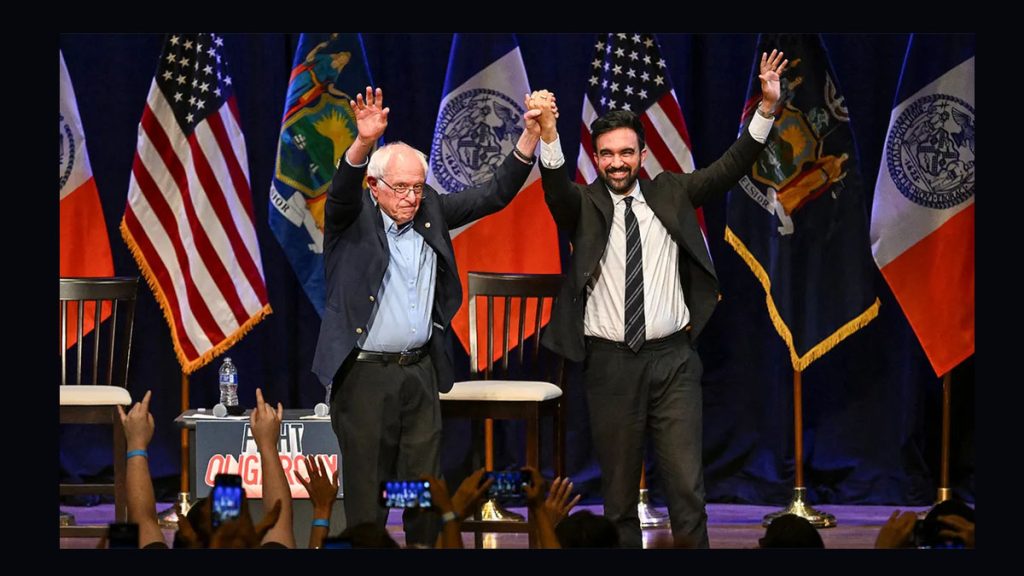
<p class="wp-block-paragraph">The Democratic Party is facing a growing internal struggle that could define its future. On one side are establishment Democrats who have dominated the party for decades. On the other is a rapidly expanding democratic socialist movement led by the Democratic Socialists of America, or DSA, a group that has grown from a few thousand members to more than 100,000 nationwide. Recent primary victories suggest that democratic socialists are no longer a fringe force. The question now is whether they represent the Democratic Party&#8217;s future power base or the beginning of a damaging split that could weaken the party for years to come.</p>


<p class="wp-block-paragraph"><strong>The Rise of the DSA</strong></p>


<p class="wp-block-paragraph">The Democratic Socialists of America has spent years building grassroots networks, organizing volunteers, and developing candidates. After several difficult years following the rise of &#8220;The Squad&#8221; in 2018, the organization now appears to be gaining momentum again.</p>


<p class="wp-block-paragraph">DSA national co-chair Megan Romer recently declared that democratic socialists offer a stark alternative to traditional Democratic messaging. &#8220;What DSA represents is a real contrast to Democrats who have run the last couple of elections on fear,&#8221; she said. &#8220;You can&#8217;t run on that. You have to offer an alternative.&#8221;</p>


<p class="wp-block-paragraph">The organization is already looking toward the 2028 presidential race. DSA plans to survey all 250 chapters nationwide and begin selecting a candidate capable of carrying the democratic socialist banner onto the national stage.</p>


<p class="wp-block-paragraph"><strong>The New York Earthquake</strong></p>


<p class="wp-block-paragraph">The clearest evidence of DSA&#8217;s growing influence came during the recent New York primaries.</p>


<p class="wp-block-paragraph">Candidates backed by New York City Mayor Zohran Mamdani swept a series of high-profile races. Claire Valdez defeated Brooklyn Borough President Antonio Reynoso. Darializa Avila Chevalier defeated incumbent Rep. Adriano Espaillat, who chaired the Congressional Hispanic Caucus. Brad Lander defeated incumbent Rep. Dan Goldman by more than 30 percentage points.</p>


<p class="wp-block-paragraph">The victories were so dramatic that even Democratic insiders struggled to describe them. One centrist House Democrat called the results an &#8220;earthquake&#8221; and a &#8220;huge defeat&#8221; for Democratic leadership. Rep. Greg Meeks admitted simply, &#8220;It was a tough night.&#8221;</p>


<p class="wp-block-paragraph">DSA candidates also won numerous state legislative races. David Orkin defeated incumbent Jennifer Rajkumar. Christian Tate defeated incumbent Erik Dilan. Eon Huntley defeated incumbent Stefani Zinerman. Samantha Kattan, Illapa Sairitupac, and Aber Kawas also secured victories. The organization appears poised to increase its representation in Albany while continuing to expand its influence nationally.</p>


<p class="wp-block-paragraph"><strong>Mamdani the Kingmaker</strong></p>


<p class="wp-block-paragraph">Although DSA leaders insist they &#8220;don&#8217;t do kingmakers,&#8221; Zohran Mamdani is increasingly becoming one.</p>


<p class="wp-block-paragraph">Virtually every major DSA-backed victory in New York carried Mamdani&#8217;s endorsement. Political observers increasingly view his operation as one of the most effective turnout machines in Democratic politics.</p>


<p class="wp-block-paragraph">Rep. Pramila Jayapal noted that &#8220;Mayor Mamdani&#8217;s endorsement and turnout machine really does matter.&#8221; Progressive Rep. Ro Khanna went even further, saying, &#8220;The energy of our party is clearly with the left.&#8221;</p>


<p class="wp-block-paragraph">Mamdani himself appears eager to shape the future. Speaking before the primaries, he rejected the idea that the presidential race begins years from now. &#8220;When does the race for 2028 begin? It starts now. It starts on Tuesday.&#8221;</p>


<p class="wp-block-paragraph">Because he was not born in the United States, Mamdani cannot run for president himself. Yet his influence over endorsements, organizing, fundraising, and voter turnout may allow him to become one of the most powerful figures in Democratic politics anyway.</p>


<p class="wp-block-paragraph"><strong>The AOC Question</strong></p>


<p class="wp-block-paragraph">No discussion of democratic socialism is complete without Alexandria Ocasio-Cortez.</p>


<p class="wp-block-paragraph">Many activists view her as the most likely candidate to carry the socialist banner in 2028. DSA leaders are openly discussing the possibility, though they insist she will not receive special treatment.</p>


<p class="wp-block-paragraph">&#8220;If it reveals that every chapter is like, &#8216;We want AOC, we want AOC,&#8217; that may be what we decide to do,&#8221; Romer said.</p>


<p class="wp-block-paragraph">For many younger activists, Ocasio-Cortez represents the future of the party. Her popularity, fundraising ability, and national profile make her a natural focal point for the movement.</p>


<p class="wp-block-paragraph"><strong>Why Moderates Are Nervous</strong></p>


<p class="wp-block-paragraph">The surge of socialist candidates has alarmed many establishment Democrats.</p>


<p class="wp-block-paragraph">Rep. Tom Suozzi warned that moderates need to &#8220;wake up&#8221; to the challenge. Another centrist Democrat argued that &#8220;appeasement doesn&#8217;t work&#8221; and that moderates must begin organizing more aggressively against the socialist movement.</p>


<p class="wp-block-paragraph">Some Democrats worry that socialist candidates can win heavily progressive urban districts but struggle in the battleground states and swing districts needed to win national elections. Even Bhaskar Sunkara, a former DSA vice-chair, acknowledged that the movement still must figure out how to compete in &#8220;deep-red and rural districts.&#8221;</p>


<p class="wp-block-paragraph">This concern is reinforced by polling.</p>


<p class="wp-block-paragraph">A Gallup survey found that 45 percent of Democrats wanted the party to become more moderate while only 29 percent wanted it to become more liberal. Third Way found that 40 percent of Democratic primary voters identify as moderate or conservative. Two-thirds believe that nominating a candidate who is &#8220;too far left&#8221; could cost Democrats a general election.</p>


<p class="wp-block-paragraph"><strong>What the Manhattan Institute Found</strong></p>


<p class="wp-block-paragraph">The Manhattan Institute&#8217;s research paints an even more complicated picture.</p>


<p class="wp-block-paragraph">Its survey found that 47 percent of Democrats fit into a moderate category. Progressive Liberals represented 37 percent, while the so-called &#8220;Woke Fringe&#8221; represented just 11 percent. Researchers concluded that Democratic voters are often &#8220;more moderate, more internally divided, and more pragmatic&#8221; than media coverage suggests.</p>


<p class="wp-block-paragraph">The study found majorities supporting capitalism over socialism, opposing the abolition of ICE, favoring sex-based athletic competition, and supporting traditional policing as the primary tool for public safety. Researchers concluded that the activist wing may exert influence far beyond its actual size because it dominates low-turnout primaries and online political discourse.</p>


<p class="wp-block-paragraph"><strong>A Party Headed for a Reckoning</strong></p>


<p class="wp-block-paragraph">The Democratic Party increasingly resembles two competing coalitions sharing the same label.</p>


<p class="wp-block-paragraph">One faction argues that economic populism, democratic socialism, and confrontational activism represent the future. The other believes the path to victory runs through moderation, coalition building, and appealing to swing voters.</p>


<p class="wp-block-paragraph">The energy today clearly belongs to the socialist wing. Primary victories, volunteer enthusiasm, and grassroots organizing all favor the insurgents. Yet the broader Democratic electorate remains significantly more moderate than many activists assume.</p>


<p class="wp-block-paragraph">That creates the possibility of a major confrontation ahead. Democratic socialists may continue winning primaries and electing candidates in deep-blue districts and cities. However, once those candidates attempt to implement aggressive socialist policies, raise taxes, expand government programs, or advance positions that moderate Democrats view as politically risky, resistance is likely to intensify.</p>


<p class="wp-block-paragraph">The result could be a growing civil war inside the party. Rather than unifying Democrats, the rise of democratic socialism may force a choice between activist enthusiasm and electoral pragmatism. If neither side is willing to compromise, the Democratic Party may discover that its greatest threat is not coming from Republicans, but from its own increasingly divided coalition.</p>


<p class="wp-block-paragraph"></p>

Democratic Socialists: New Power Base or Fatal Split for Democrats?