


<p class="wp-block-paragraph">I first visited China in 1999 – and traveled there with employees, clients, and family two or three times a year until I switched from my consulting business to my writings in 2012. </p>


<p class="wp-block-paragraph">It was arguably the best of times to be in China for business and pleasure. ; It was that sweet spot between the dark days of Chairman Mao Zedong and the current twilight era of President Xi Jinping.</p>


<p class="wp-block-paragraph">I saw first-hand how the people of China embraced newfound freedoms as the old Communist regulations started to ease. ; (I did not say ended but STARTED to ease.)</p>


<p class="wp-block-paragraph">Seeing the growing unrest in authoritarian nations, I am inclined to borrow President Lincoln’s mantra. ; You can oppress some of the people all the time … all the people some of the time … but not all the people all the time. ; That seems to be playing out among the most oppressive and brutal authoritarian regimes –specifically China, Russia, Iran, and Venezuela.</p>


<p class="wp-block-paragraph">The most significant major exception seems to be North Korea – where Kim Jong-un has been able to keep the lid on public discontent. ; Perhaps that is because the people of North Korea have never had a taste of freedom. ; And also, because North Korea remains a closed society without the Internet and international communications.</p>


<p class="wp-block-paragraph">The others mentioned above have had a taste of freedom. They are less isolated – with the average person being able to send and receive communications to and from the rest of the world. Many have traveled outside their homeland – and interacted with visitors from all parts of the world. Western business and tourism were growth industries.</p>


<p class="wp-block-paragraph">Hong Kong still has the memory of the freedoms and benefits of British rule. ; Beijing promised to maintain HK’s unique democratic freedoms under its One Nation/Two Systems policy. ; Xi has essentially ended that policy in response to the recent demonstrations in the island province.</p>


<p class="wp-block-paragraph">Not since the Tiananmen Square massacre in 1989, has there been such a level of civil unrest in the Middle Kingdom. ; Ostensibly, it is a response to the restrictive policies of the Chinese government in response to Covid 19 and its offspring.</p>


<p class="wp-block-paragraph">Ironically, as the world is seeing the Covid Pandemic state that started in China in the rearview mirror, the Beijing government is imposing the most Draconian restriction in the world. ; The people of China are figuratively – and in many cases, literally – under house arrest. ; Many have been sealed in their apartment buildings by fencing and sealed doors. ; Residents are even prevented from going to grocery stores or doctors’ offices. ; Others have security guards preventing residents from leaving. ; There are virtually no social events.</p>


<p class="wp-block-paragraph">And if you do contract Covid, you will be taken to a quarantine facility – and your family may be confined to their homes. ; Where there is a breakout, an entire section of the city may be locked down.</p>


<p class="wp-block-paragraph">That is pretty bad – but the Pandemic and the government&#8217;s reaction are not the only issues driving the street protests. ; They are only the wick that lit the powder keg. ; The issues run much deeper. ; We can see that because relaxing the restrictions is not the only demand. ; They want to end China’s surveillance policies … government censorship … government surveillance … ; “education” campaigns … and restore a wide range of personal freedoms.</p>


<p class="wp-block-paragraph">Before President Xi, the people saw the benefits of capitalism and free market trade. ; They felt relief as old Mao Zedong’s oppressive practices were lifted and the Bamboo Curtain was eliminated – providing a free flow of information between the people of China and the rest of the world. ; ; ;</p>


<p class="wp-block-paragraph">That all changed when Xi came to power. ; Even though his father and family were victims of Mao’s deadly Cultural Revolution, Xi was not driven to reform, but to be the man in charge of the oppression.</p>


<p class="wp-block-paragraph">While the demonstrations in China are unprecedented, one should not underestimate the power of a brutal authoritarian ruler to oppress the people. ; To change that would take a revolution, and China is nowhere near that stage – unfortunately.</p>


<p class="wp-block-paragraph">So. There ‘tis.</p>

Chinese unrest is serious … but not game changing
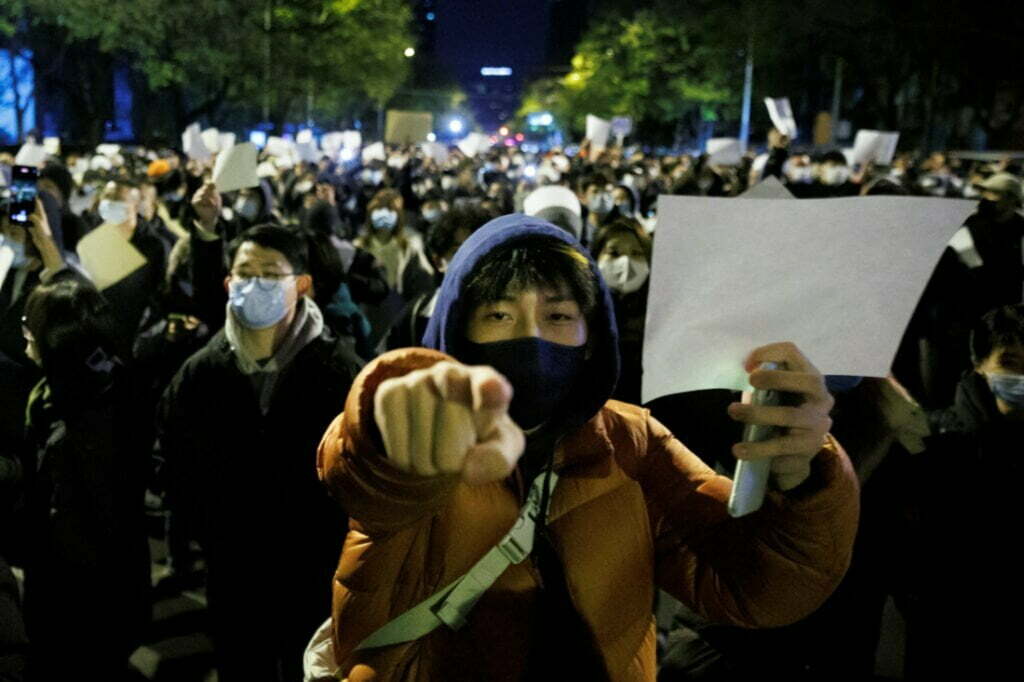
People hold white sheets of paper in protest over coronavirus disease (COVID-19) restrictions, after a vigil for the victims of a fire in Urumqi, as outbreaks of COVID-19 continue, in Beijing, China, November 27, 2022. REUTERS/Thomas Peter