<p class="wp-block-paragraph">In many ways, I am what some call an “old China hand.” ; I have traveled to the Middle Kingdom on several occasions – from 1999 to 2010. ; I have brought business delegations to China. ; For about 4 years, I served as Foreign Investment Advisor to the city of Harbin in the Northern Province of Heilongjiang. ; In that role I was to advise the city leaders how to move policies to more capitalistic and free-market positions.</p>


<p class="wp-block-paragraph">At the time, there was a lot of enthusiasm for the economic reforms launched by Chairman Deng Xiaoping. ; I recall the Communist General Secretary of the Province asking me to recommend an American college for his son. ; I was surprised when he added a caveat – that he wanted his son to attend a school that teaches Milton Friedman economics. ; ;</p>


<p class="wp-block-paragraph">During my years in China, Hong Kong and Macau were part of a “two system one China” policy – with HK and Macau maintaining a very free-market economic system. ; I recall the Governor of Heilongjiang grumbling that he wanted the Hong Kong system.</p>


<p class="wp-block-paragraph">The free-market capitalistic system was on the rise. ; During the years of my association with China, I saw the progress in real time. ; The changes included the elimination of a requirement that all foreign business had to have a Chinese partner – many times the Peoples’ Liberation Army. ; While that remained the case for certain industries – such as communications and defense – most foreign companies could set up shop in China.</p>


<p class="wp-block-paragraph">When I first arrived in China, getting U.S. investment returns out of China was a Herculean task. ; Over time, the restrictions eased. ; The policy that the government owned and controlled all real property was relaxed. ; While the government technically maintained ownership, people could acquire homes on the market. ; Then to pass them on to others for case. ; They could leave the property to their children.</p>


<p class="wp-block-paragraph">There was an assumption that the trajectory toward capitalism would be maintained for the foreseeable future. ; At one point, I was convinced that the 21<sup>st</sup> Century would belong to China. ; They had the natural resources, a very large market with increasing discretionary spending. ; At one point, China’s economic growth topped 9 percent while the U.S. growth rate was an anemic 2 to 3 percent.</p>


<p class="wp-block-paragraph">Money was flowing into China as the country became the factory to the world. ; This was the rewards of free-market capitalism even in the limited version found in China.</p>


<p class="wp-block-paragraph">My involvement in China ebbed just about the time Xi Jinping came to power. ; It never occurred to me at the time, but maybe it was BECAUSE he came to power. ; Initially, Xi seemed like a continuation of the more recent Chinese leaders. ; But that began to change – gradually at first. ; ;</p>


<p class="wp-block-paragraph">It turns out that Xi was more of an old-style doctrinaire Communist. ; He was not eager to undermine the benefits of free (or at least freer) markets, but he wanted to tighten the grip on social and political life of the Chinese. ; And he also had more expansionist ambitions than his predecessors.</p>


<p class="wp-block-paragraph">Xi undertook to initiatives. ; One was to create an internal uniformity by oppressing the diversity in the western provinces. ; He did this by suppressing diversity and dissent with brute force and by populating the region with more traditional Chinese. ; It was the same method that Chinese leaders had earlier employed to overcome the Russian population that had founded Harbin.</p>


<p class="wp-block-paragraph">Xi essentially ended the “one China, two systems” policy by crushing the democracy movement in Hong Kong. ; And he is looking lustfully at Taiwan.</p>


<p class="wp-block-paragraph">Xi has tightened down on his domestic population. ; He controls the technology. ; He can spy on the public social media platforms – and even shut them down. ; He is using facial recognition and social scoring to identify and discourage criticism. ; The people of China are not as free as they were just a decade ago.</p>


<p class="wp-block-paragraph">For centuries, China was not a global expansionist nation. ; Though they backed the northern force in Korea and Vietnam during those wars, they never attempted to occupy the country. Up until the re-opening of China by President Nixon in 1973, China had a very limited foreign policy. ; China and Russia were the two major Communist nations in the world, but they were not as closely aligned as many believe. ; Heilongjiang Province – which is surrounded by Russia on three sides – built a massive string of bomb shelters. ; It was not to protect from an American attack, but from Russia.</p>


<p class="wp-block-paragraph">Xi turned China into an aggressive global competitor to the United States. ; He is not a warmonger – and not even much of a saber-rattler. ; But he is ruthlessly competitive on the world scene. ; The Chinese business community is on the ground in Africa and South America – buying up resources, financing public works projects. ; His goal is to replace the United States as the go-to country.</p>


<p class="wp-block-paragraph">To do that, China would need the most powerful military in the world. ; Xi well understood that military strength was America’s ace-in-the-hole. ; Xi may not officially control the strongest military in the world, but it is strong enough to deter any aggressor. ; If China uses the military to take control of the South China Sea – as Xi has promised to do – what country will stop him?</p>


<p class="wp-block-paragraph">If Xi decided to use his military to take over Taiwan, who will stop him? ; The United States has a defense treaty with Taiwan, but following the Biden debacle in Afghanistan, Xi mocked the United States – intimating that Taiwan cannot depend on America.</p>


<p class="wp-block-paragraph">To expand China’s influence, Xi has an M&;M strategy – money and military. It worked for the United States for the better part of the 20<sup>th</sup> Century. ; Xi believes that the United States can no longer compete financially or militarily with China – and that it is only a matter of time until China is recognized as the world leader.</p>


<p class="wp-block-paragraph">But there is a conundrum. ; The unprecedented success of China in the past 70 years has been the result of shifting the economy from a centrally controlled model to a free-market model. ; But free market capitalism thrives best in an environment of political and personal freedom. ; Xi seems to be experimenting with a model of oppressive government and free trade. ; Professor Barry Naughton, an expert on the Chinese economy from the University of California, San Diego calls it “a government-steered economy.” ;</p>


<p class="wp-block-paragraph">When it comes to the major business enterprise, Xi wants them under the thumb of Beijing. ; And it is not just foreign enterprises. ; He is essentially taking control of such popular Chinese companies like Alibaba. ; Xi sees the private enterprise as a threat to his authoritarian style of governance. ; They are too big – and unfettered they have too much influence among the people.</p>


<p class="wp-block-paragraph">Can Xi get away with this hybrid economy – with some level of free markets and absolute control from Beijing?</p>


<p class="wp-block-paragraph">It may all depend on what the western nations do in the coming years. ; Will they undermine China’s role as a world economic leader by restraining trade and even imposing sanctions – the political solution. ; Or will they continue to make deals with China – the pure economic approach?</p>


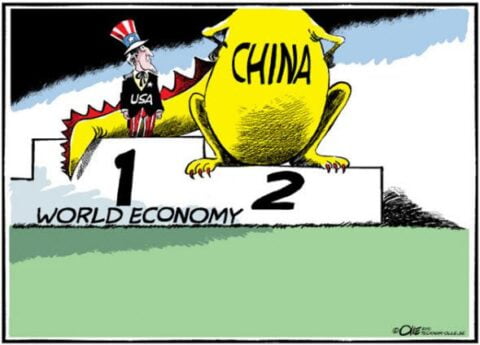
<p class="wp-block-paragraph">Whether China becomes the king of the world mountain will depend a lot on the one country trying to cling to its leadership – the United States. ; The answer will be revealed in the next few years.</p>


<p class="wp-block-paragraph">So, there ‘tis.</p>

China’s Xi is going back to the future