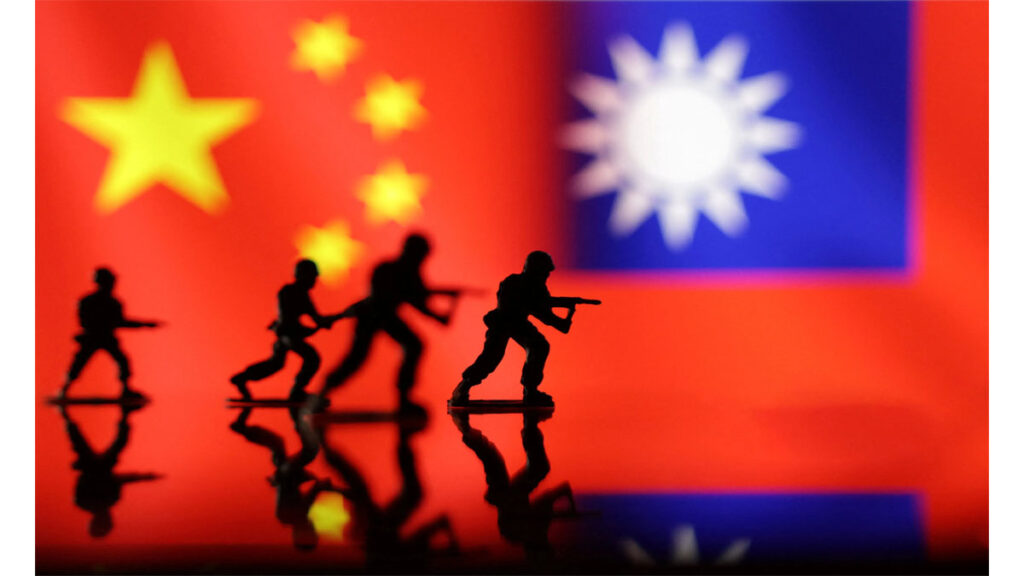
<p>In a detailed report led by Dan Blumenthal from the American Enterprise Institute, &#8220;From Coercion to Capitulation: How China Can Take Taiwan Without a War,&#8221; the potential strategies China could employ to assert control over Taiwan without resorting to a military invasion are meticulously analyzed. While the fear of a full-scale invasion has long dominated U.S. strategic discussions, a more likely and subtle approach involves a comprehensive coercion campaign by the People’s Republic of China (PRC). This strategy, referred to as the short-of-war coercion course of action (SoWC COA), is already in play and could lead to Taiwan’s capitulation without a single shot being fired.</p>


<p>In this report, the short-of-war coercion course of action (SoWC COA) identifies four key centers of gravity that China aims to target to bring Taiwan under its control. Understanding these centers of gravity is essential to grasp the full extent of China’s strategy and the necessary countermeasures. Each center of gravity represents a critical source of strength and resistance that China seeks to weaken through its coercion campaign.</p>


<h4 class="wp-block-heading" id="h-1-the-u-s-taiwan-strategic-relationship">1. The U.S.-Taiwan Strategic Relationship</h4>


<p>The strategic partnership between the United States and Taiwan is a cornerstone of Taiwan’s security and international standing. This relationship encompasses comprehensive bilateral cooperation in military, economic, and diplomatic domains. China’s strategy aims to weaken this partnership through economic carrots and sticks, information operations, and military posturing. By convincing both the U.S. and Taiwan that their cooperation leads to further escalation and instability, China hopes to sever this critical link. The goal is to make both nations believe that peace and prosperity can only be achieved by halting their partnership, thereby isolating Taiwan from its most powerful ally.</p>


<h4 class="wp-block-heading" id="h-2-the-roc-government-s-ability-to-function">2. The ROC Government’s Ability to Function</h4>


<p>The ability of the Republic of China (ROC) government to provide essential services and maintain governance is another vital center of gravity. China’s strategy includes economic warfare, cyberattacks, sabotage, and pseudo-legal maritime inspections aimed at disrupting Taiwan’s supply chains. These actions are designed to drastically decrease the standard of living in Taiwan, erode public confidence in the government, and portray the ROC as incapable of managing the island’s affairs. By undermining the government’s legitimacy, China hopes to create a crisis of governance that forces Taiwanese leaders to seek a settlement with Beijing.</p>


<h4 class="wp-block-heading" id="h-3-the-taiwanese-public-s-will-to-resist">3. The Taiwanese Public’s Will to Resist</h4>


<p>The will of the Taiwanese people to resist unification with China is a formidable barrier to Beijing’s ambitions. Extensive and persistent cognitive and psychological campaigns are employed to intimidate and demoralize supporters of Taiwanese independence. These campaigns aim to sow doubt and fear among the population, making them question the viability of continued resistance. By creating an environment of constant pressure and instability, China hopes to generate a groundswell of demand for political concessions in exchange for peace and stability.</p>


<h4 class="wp-block-heading" id="h-4-u-s-public-and-political-willingness-to-support-taiwan">4. U.S. Public and Political Willingness to Support Taiwan</h4>


<p>The willingness of the U.S. public and political leadership to support Taiwan is crucial for maintaining international resistance against Chinese coercion. China’s information campaigns target American perceptions, aiming to decrease U.S. support for Taiwan by highlighting the risks and costs associated with defending the island. By promoting narratives that suggest U.S. support for Taiwan provokes unnecessary conflict and distracts from domestic issues, China seeks to weaken American resolve. This decreased support would leave Taiwan more vulnerable and isolated, making it easier for Beijing to achieve its objectives.</p>


<h3 class="wp-block-heading" id="h-china-s-coercion-strategy">China’s Coercion Strategy</h3>


<p>The report identifies several methods the PRC could use to coerce Taiwan into political submission:</p>


<ol class="wp-block-list">
<li><strong>Economic Coercion</strong>: The PRC can use its economic influence to isolate Taiwan from global markets. By imposing trade restrictions, controlling vital supply chains, and leveraging its market power, China can significantly harm Taiwan&#8217;s economy. This could include sanctions on Taiwanese goods, restricting imports essential to Taiwan&#8217;s high-tech industries, and pressuring multinational companies to reduce or eliminate their business operations in Taiwan. These actions would create economic instability and increase unemployment, thereby undermining public confidence in the Taiwanese government.</li>


<li><strong>Cyber and Information Warfare</strong>: By launching cyberattacks on critical infrastructure and spreading disinformation, China can create instability and mistrust within Taiwan. Cyberattacks could target Taiwan&#8217;s power grids, water supply systems, financial institutions, and government databases, leading to widespread disruptions. Concurrently, information warfare tactics such as disinformation campaigns, fake news, and social media manipulation can exacerbate internal divisions, fuel political polarization, and erode public trust in the government. These actions would weaken the government&#8217;s ability to function effectively and maintain social order.</li>


<li><strong>Military Posturing</strong>: Increasing military presence and conducting exercises near Taiwan serve to intimidate and demonstrate the potential for force. This creates a constant state of threat without crossing the threshold into open conflict. Regular incursions into Taiwan’s air defense identification zone (ADIZ), naval patrols around the island, and missile tests would exhaust Taiwan&#8217;s defense resources and keep its military on high alert. The PRC could also engage in psychological operations to demoralize Taiwanese forces and civilian populations, portraying Taiwan’s defense as futile against China’s overwhelming military might.</li>


<li><strong>Diplomatic Isolation</strong>: China can pressure other countries to sever official ties with Taiwan and prevent it from participating in international organizations. This diplomatic isolation can erode Taiwan&#8217;s international support and legitimacy. The PRC&#8217;s extensive diplomatic network and economic leverage can be used to coerce nations into adopting a One-China policy, thereby reducing Taiwan’s global footprint. By isolating Taiwan diplomatically, the PRC aims to undermine its de facto independence and push it towards unification with the mainland under Beijing’s terms.</li>
</ol>


<h3 class="wp-block-heading" id="h-recommendations-to-counter-prc-coercion">Recommendations to Counter PRC Coercion</h3>


<p>To counteract these coercive strategies, the report provides four key recommendations for the United States and its allies:</p>


<ol class="wp-block-list">
<li><strong>Strengthen Economic Resilience</strong>: Taiwan must diversify its economic partners and reduce dependence on China. The U.S. and allies should assist Taiwan in building a more resilient economy through trade agreements, economic support, and investment in critical industries such as semiconductor manufacturing. Encouraging multinational corporations to maintain or expand their operations in Taiwan and integrating Taiwan into regional trade frameworks like the Comprehensive and Progressive Agreement for Trans-Pacific Partnership (CPTPP) would also bolster economic resilience.</li>


<li><strong>Enhance Cybersecurity and Information Defense</strong>: Improving Taiwan&#8217;s cybersecurity infrastructure and countering disinformation are critical. This includes sharing intelligence, providing cybersecurity training, and supporting independent media to ensure accurate information dissemination. The U.S. and its allies can help Taiwan develop robust cyber defense capabilities, conduct joint cyber exercises, and establish rapid response teams to mitigate the impact of cyberattacks. Public awareness campaigns to educate Taiwanese citizens about disinformation and promote media literacy can also strengthen societal resilience against information warfare.</li>


<li><strong>Bolster Military Readiness and Cooperation</strong>: The U.S. and its allies should enhance military cooperation with Taiwan, including joint exercises, arms sales, and strategic planning. This demonstrates a tangible commitment to Taiwan&#8217;s defense. Regular joint military exercises can improve interoperability between Taiwanese and allied forces, ensuring a coordinated response in case of aggression. Providing advanced defensive weaponry, such as anti-ship missiles, air defense systems, and coastal defense equipment, can enhance Taiwan’s deterrence capabilities. Additionally, contingency planning and intelligence sharing would enable better preparedness for potential PRC actions.</li>


<li><strong>Expand Diplomatic Engagement</strong>: Increasing Taiwan&#8217;s international presence and support from other democracies is crucial. The U.S. should lead efforts to include Taiwan in international organizations and forums, ensuring it remains a recognized and supported entity on the global stage. Promoting Taiwan’s participation in global health, environmental, and trade organizations can reinforce its international legitimacy. Building a coalition of like-minded democracies to advocate for Taiwan’s inclusion and supporting its diplomatic initiatives can counteract PRC’s efforts to isolate Taiwan. Moreover, high-level visits and public statements of support from international leaders can signal unwavering commitment to Taiwan’s autonomy.</li>
</ol>


<p>Blumenthal’s report underscores the necessity of a multifaceted approach to counter China&#8217;s coercive tactics. By strengthening Taiwan&#8217;s economic resilience, enhancing cybersecurity, bolstering military readiness, and expanding diplomatic engagement, the U.S. and its allies can help Taiwan resist PRC&#8217;s coercive efforts and maintain its autonomy. This comprehensive strategy is essential for safeguarding the strategic interests of the U.S. and its partners in the Indo-Pacific region, ensuring that Taiwan remains a critical ally in maintaining regional stability and countering PRC aggression.</p>


<p><strong>ACZ Editor&#8217;s Note:</strong> Add to this more covert methods, like coercion of individuals within the government, discrediting of anti-China, pro-democracy leaders and much more, and you will find this is hugely powerful, and it could eventually work. Taiwan can vote over and over again for independence and democracy, but it only takes one vote in favor of China for it all to do away.</p>


<p><a href="https://www.understandingwar.org/sites/default/files/From-Coercion-to-Capitulation-How-China-Can-Take-Taiwan-Without-a-War%20%281%29.pdf">https://www.understandingwar.org/sites/default/files/From-Coercion-to-Capitulation-How-China-Can-Take-Taiwan-Without-a-War%20%281%29.pdf</a></p>

China’s Tactics to Win Taiwan Without Invasion