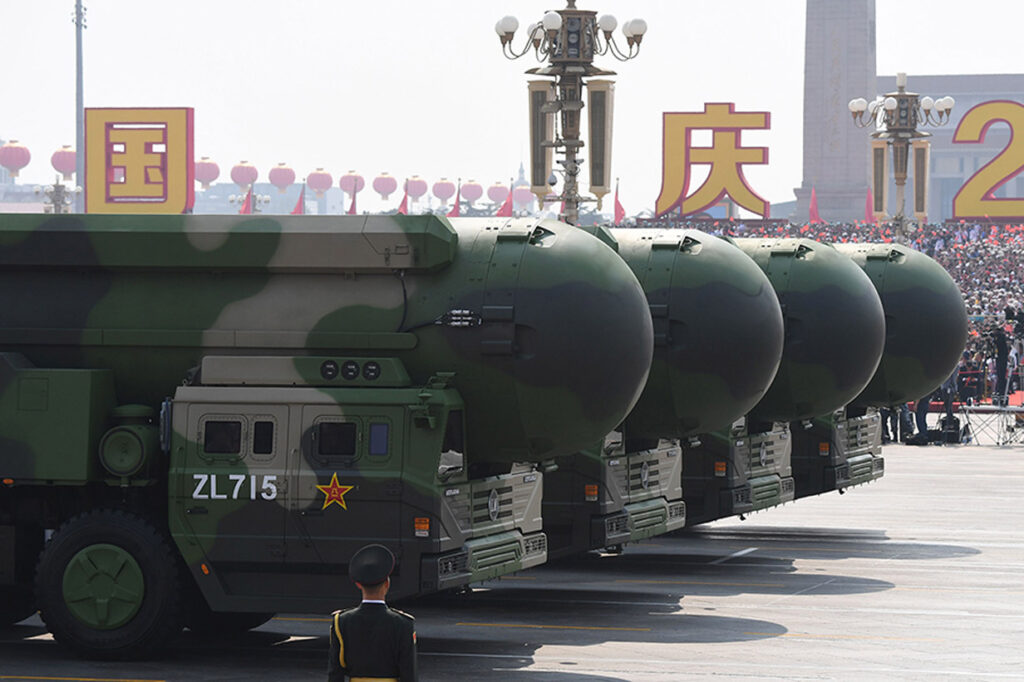
<p class="wp-block-paragraph">The Pentagon has issued a stark warning about China&#8217;s burgeoning long-range missile arsenal, underscoring Beijing&#8217;s drive to become a formidable military force on the world stage. According to a comprehensive report from the US Department of Defense, China now possesses more than 500 operational nuclear warheads, surpassing previous estimates. Furthermore, it may be exploring the development of conventionally-armed long-range missiles with the potential to reach the United States. These revelations paint a concerning picture of China&#8217;s ambitions and its desire to assert dominance not only in the Pacific region but globally.</p>


<p class="wp-block-paragraph">ACZ wrote previous that the U.S. had massively underestimated China&#8217;s military budget, closer to $700 Billion, rather than the $</p>


<p class="wp-block-paragraph">The 2023 China Military Power report, an annual assessment by the Pentagon, highlights China&#8217;s rapid military modernization efforts. Beijing is actively bolstering its military capabilities across multiple domains, including land, air, sea, nuclear, cyber, and space. This formidable military expansion has grave implications for regional and global security.</p>


<p class="wp-block-paragraph">One alarming development outlined in the report is the construction of three new fields of long-range ballistic missile silos by China. These silos could serve as launch platforms for nuclear warheads, underscoring China&#8217;s intent to diversify its options for delivering these potentially devastating payloads. This revelation raises serious concerns among defense officials in the United States.</p>


<p class="wp-block-paragraph">The Pentagon&#8217;s senior defense officials have expressed their concerns about China&#8217;s lack of transparency regarding its nuclear buildup. They are calling for greater transparency and a willingness to engage in discussions on strategic stability and risk reduction. The absence of such openness creates an atmosphere of uncertainty and mistrust on the global stage.</p>


<p class="wp-block-paragraph">China&#8217;s efforts to produce plutonium for its nuclear weapons program also come under scrutiny in the report. Despite Beijing&#8217;s claims that these technologies are for peaceful purposes, the report suggests that they are being utilized to expand its nuclear arsenal. Such actions only heighten tensions and exacerbate concerns regarding China&#8217;s intentions.</p>


<p class="wp-block-paragraph">The United States has designated China as the &#8220;pacing challenge&#8221; in its National Defense Strategy. This designation underscores China&#8217;s capacity to compete with the US in terms of military might, economic power, and international influence. China already boasts the largest standing army, the largest navy by ship count, and the largest air force in the region.</p>


<p class="wp-block-paragraph">China&#8217;s military might is not confined to its borders but extends to its efforts to assert sovereignty in disputed regions, such as the South China Sea and Taiwan. In 2022, China escalated its aggressive actions towards Taiwan, including ballistic missile overflights and military aircraft incursions into Taiwan&#8217;s airspace. Chinese President Xi Jinping has stated his desire for the peaceful unification of Taiwan with China, but he has not ruled out the use of military force to achieve this goal. These actions underscore China&#8217;s willingness to wield its military power to achieve its objectives.</p>


<p class="wp-block-paragraph">China&#8217;s assertiveness is not limited to its immediate neighbors. Chinese military pilots have engaged in what the Pentagon describes as &#8220;coercive and risky&#8221; behavior towards US aircraft flying over the East and South China Seas in recent years. These incidents have occurred more than 180 times, with Chinese jets coming perilously close to US military aircraft. The goal appears to be coercing a change in US operational activities in the region, a concerning pattern of behavior that heightens tensions.</p>


<p class="wp-block-paragraph">Despite these challenges, the US remains frustrated by China&#8217;s reluctance to engage in high-level military-to-military channels. While some communication continues at lower levels, maintaining open lines of communication at all levels, including the highest, is crucial for de-escalating tensions and preventing misunderstandings.</p>


<p class="wp-block-paragraph">In sum, China&#8217;s growing nuclear arsenal and assertive military posture raise significant concerns for regional and global stability. The Pentagon&#8217;s report serves as a stark reminder of the need for greater transparency, dialogue, and diplomacy to address these pressing issues. The world watches closely as China&#8217;s military ambitions continue to evolve, with far-reaching implications for international security.</p>

China’s Expanding Nuclear Arsenal – Is China Ready to Throw Its Weight Around?