<p class="wp-block-paragraph">China’s dominance in global manufacturing has become one of the most pressing economic challenges of the 21st century. Over the past two decades, the country has transformed itself from a secondary player into an industrial superpower, reshaping global supply chains and destabilizing competitors in the United States and Europe. During President Biden’s administration, this trend accelerated, raising concerns about the future of American manufacturing and the broader global economy. The question is not just how China achieved this dominance but how the U.S. allowed it to deepen during a critical period.</p>


<p class="wp-block-paragraph">China’s manufacturing boom has propelled it into a unique position. By 2023, China’s manufacturing value-added reached $4.66 trillion, accounting for 29% of global output. As one expert noted, “China’s production exceeds that of the nine next largest manufacturers combined.” This staggering growth has allowed China to undercut competitors with low prices, leaving domestic industries in countries like the United States struggling to survive.</p>


<figure class="wp-block-image size-large"><img src="https://anticommunist.zone/wp-content/uploads/2025/01/image-1024x576.png" alt="" class="wp-image-2681"/></figure>


<h4 class="wp-block-heading" id="h-china-s-path-to-manufacturing-dominance">China’s Path to Manufacturing Dominance</h4>


<p class="wp-block-paragraph">China’s ascent to manufacturing supremacy was not accidental. It was the result of deliberate policies and structural advantages that the country used to its full potential. Key factors include its vast supply of low-cost labor, economies of scale, and significant government support. A historical turning point was China’s accession to the World Trade Organization (WTO) in 2001, which granted it access to favorable trade agreements and opened the door to an influx of foreign investment.</p>


<p class="wp-block-paragraph">According to data from the OECD, China’s share of global manufacturing output surged from just 6% in 2000 to nearly 30% by 2023. This shift happened rapidly. “China passed Germany in 1998, Japan in 2005, and the U.S. in 2008,” writes Professor Richard Baldwin, who has studied China’s industrial rise extensively. “Since then, China has more than doubled its world share while the U.S.’s share has fallen by another three percentage points.”</p>


<p class="wp-block-paragraph">China’s manufacturing capabilities evolved from producing low-value goods like textiles to dominating high-value sectors like electronics and renewable energy technologies. In 1995, textiles accounted for 20% of China’s total exports, while electronics were less than 9%. By 2020, the reverse was true, with electronics comprising 24% of exports and textiles only 10%. This transformation, often referred to as “climbing the value chain,” required significant investment in infrastructure and technology.</p>


<h4 class="wp-block-heading" id="h-manufacturing-gains-during-the-biden-years">Manufacturing Gains During the Biden Years</h4>


<p class="wp-block-paragraph">While China’s rise to manufacturing dominance began decades ago, the Biden administration saw this trend deepen. Despite promises to prioritize American manufacturing, Biden’s policies largely failed to counter China’s advancements. Though tariffs imposed during the Trump administration remained in place, they were not expanded in a meaningful way. Instead, Chinese manufacturers adapted by finding new markets, subsidizing factories, and even shifting production to other countries to evade trade restrictions.</p>


<p class="wp-block-paragraph">Under Biden’s leadership, the U.S. failed to match China’s strategic investments in industrial policy. China’s “Made in China 2025” initiative aims to dominate ten key sectors, including robotics, aerospace, and biopharmaceuticals, with massive government support. By 2019, China was spending the equivalent of over 1.7% of its GDP on industrial policy—more than four times the U.S. level at that time. This disparity highlights the lack of urgency in U.S. policy.</p>


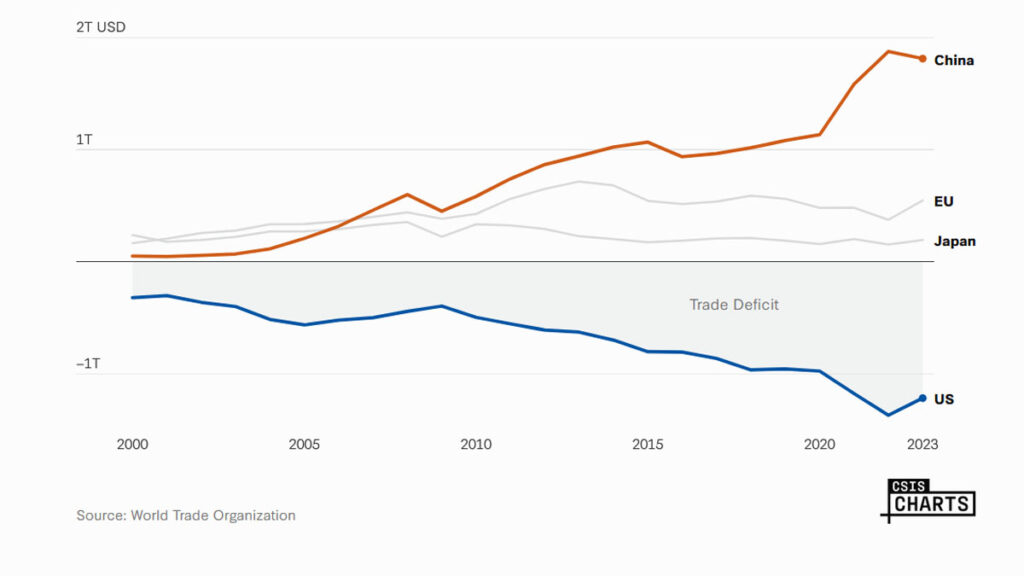
<p class="wp-block-paragraph">During this period, China’s trade surplus ballooned to an unprecedented $1 trillion in 2024, triple what it was in 2018. The gap between U.S. imports and exports with China widened, leaving the U.S. increasingly dependent on Chinese goods. As Baldwin observed, “China is now the world’s sole manufacturing superpower&#8230; and the asymmetric impact that its dominance has had on global supply chains is undeniable.”</p>


<h4 class="wp-block-heading" id="h-what-china-excels-at-and-where-it-falls-short">What China Excels At—and Where It Falls Short</h4>


<p class="wp-block-paragraph">China’s manufacturing strength lies in its ability to produce a wide range of goods, often at prices that competitors cannot match. Electronics, machinery, textiles, and consumer goods are among its top exports. Recently, China has surged ahead in strategic sectors like electric vehicles (EVs) and lithium-ion batteries. By leveraging innovation and affordability, Chinese EV manufacturers have captured significant global market share, even outpacing traditional automotive giants in some regions.</p>


<p class="wp-block-paragraph">However, China still lags in certain high-tech areas, particularly semiconductors and aircraft. Despite decades of investment, China remains heavily reliant on foreign chip manufacturing equipment and expertise. “China’s semiconductor industry continues to import critical manufacturing equipment,” noted one report, “leaving it exposed to U.S.-led export controls.” Similarly, while China has made strides with its domestically developed COMAC C919 aircraft, it still relies on imported components, keeping it dependent on U.S. and European manufacturers like Boeing and Airbus.</p>


<h4 class="wp-block-heading" id="h-the-danger-of-overdependence">The Danger of Overdependence</h4>


<p class="wp-block-paragraph">The global reliance on Chinese manufacturing presents a significant geopolitical risk. For decades, developed countries like the United States have prioritized cheap goods over the security of their domestic industries. This overdependence on China became starkly evident during the COVID-19 pandemic, when supply chain disruptions caused widespread shortages.</p>


<p class="wp-block-paragraph">The asymmetry in supply chain reliance is striking. “The U.S. relies far more on Chinese manufacturing production than vice versa,” Baldwin observed. This imbalance gives China leverage over critical industries and raises the stakes for potential trade disputes or geopolitical tensions. Furthermore, China’s practice of flooding global markets with subsidized goods creates distortions that undermine fair competition.</p>


<h4 class="wp-block-heading" id="h-the-way-forward-for-the-united-states">The Way Forward for the United States</h4>


<p class="wp-block-paragraph">The United States must take decisive action to counter China’s manufacturing dominance. First, it needs to invest heavily in its own industrial base, particularly in high-tech sectors like semiconductors and renewable energy. Federal funding, tax incentives, and infrastructure improvements are critical to supporting American manufacturers.</p>


<p class="wp-block-paragraph">Second, the U.S. should work closely with allies to reduce reliance on Chinese supply chains. By building resilient networks with Europe, Japan, and other partners, the U.S. can create alternative sources for critical goods. Trade policies should also be targeted to protect vulnerable industries from unfair competition.</p>


<p class="wp-block-paragraph">Lastly, fostering innovation is key. The U.S. must prioritize research and development to remain competitive in emerging technologies. China’s rapid advancements in R&;D, especially in manufacturing-related fields, are closing the gap with the U.S., making it essential to double down on innovation.</p>


<p class="wp-block-paragraph">China’s manufacturing dominance represents one of the greatest economic and geopolitical challenges of our time. During the Biden years, the U.S. failed to mount an effective response, allowing China to solidify its position as the world’s leading industrial power. Without bold action, the United States risks falling further behind, with dire consequences for its economy and global influence.</p>


<p class="wp-block-paragraph"></p>

China is a Manufacturing SuperPower – Biden Made It Much Worse