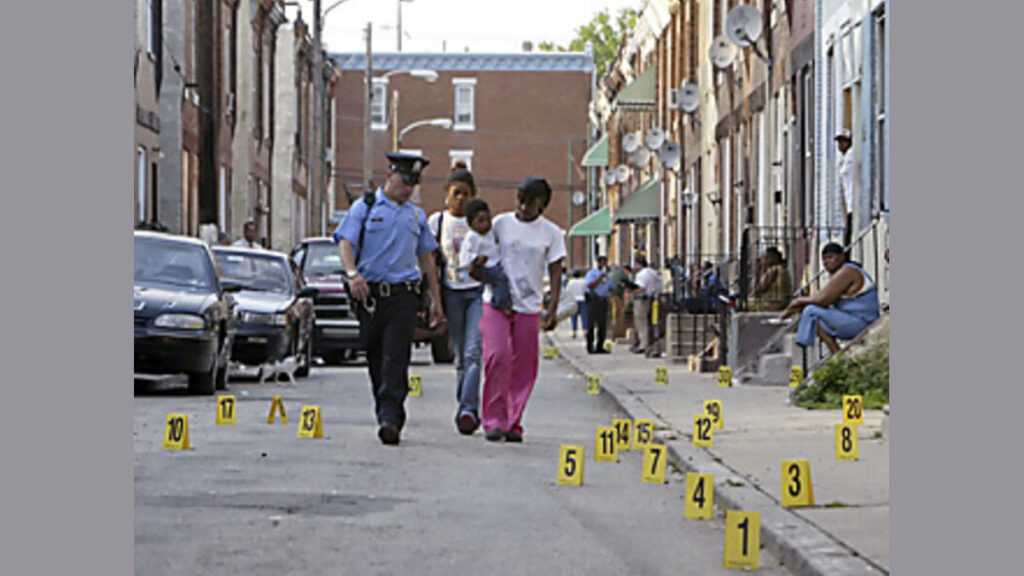
<p>Life in the modern ghetto today is imperiled in many ways. Ramshackle housing is dangerous and occasionally deadly. Healthcare is inadequate. Drugs, gang violence and murder are part of daily life. Residents go to bed hearing gun shots. Innocent men, women and children are killed virtually every day. Police are too often seen as racist in law enforcement. Unemployment and poverty are the twin realities of life in the segregated ghettoes of America’s great cities.</p>


<p>The culture of impoverishment and oppression starts with a lack of education – as noted in my book “Who Put Black Americans in That PLACE? The Long Sad History of the Democratic Party’s Oppression of Black Americans &#8230; to This Day”. Inferior education removes millions of young Black men and women from advanced schooling and career-level employment. It destroys their futures – and is a loss to the nation.</p>


<p>The urban school systems serving Black students have the same “separate and unequal” quality that characterized the racist school districts of the old South.</p>


<p><strong><em>“Of all the elements of institutional de facto racism, none is more damaging and immoral than the unwillingness to provide millions of young Black students with a quality education that can lead to college and career level employment.</em></strong></p>


<p><strong><em>Lack of proper education leads to unemployment and poverty, which leads to substandard housing and crime. It restricts social and economic upward mobility. It imposes the reliance on generational welfare dependence. It keeps Blacks in that PLACE.</em></strong></p>


<p><strong><em>The racism becomes obvious when you compare schools in the segregated communities to the education provided in the predominantly White schools in the same school districts. No difference in union representation. No difference in curriculum. Both schools are governed by the same school board and the same municipal administrations. And yet funding and outcomes are remarkably different.”</em></strong></p>


<p>Funding is not the issue, as many contend.</p>


<p><strong><em>“In 2018 in New York City, the average spending in Black schools was $28,808 per pupil and $24,173 for White pupils. In Chicago, it was $16,226 for Blacks. This did not change educational outcomes, however. Regardless of funding increases, the achievement levels in the Black segregated schools remained significantly lower than White schools in the same school system. That points directly to institutional racism as the primary reason—not money.”</em></strong></p>


<p><strong><em>* * *</em></strong></p>


<p><strong><em>In the mid-1990s, a new term entered the lexicon to re-label the academic experience of inner-city Black students. ‘Warehousing’ basically is the act of storing student bodies in a school building in which there is poor quality education.</em></strong></p>


<p><strong><em>Without basic education, Black students are so ill-prepared for anything but unskilled labor that major corporations have had to undertake intensified remedial training just to find sufficient workers. Ronald J. Gidwitz, the former chief executive officer for the Helene Curtis cosmetics company, said that his company had to set up a high school level training program to enhance the job skills of Black public high school graduates before they could enter into his company’s work force.</em></strong></p>


<p><strong><em>In an October 8, 2014, editorial, the Los Angeles Times succinctly defined the problem: ‘Too often, students spend weeks pleading for access to classes they need to graduate or apply to college. Many are assigned to multiple periods of empty class time every day.’</em></strong></p>


<p><strong><em>According to the editorial, the situation was sufficiently serious to warrant legal action:</em></strong></p>


<p><strong><em>The American Civil Liberties Union, Public Counsel and others are suing California on behalf of students, claiming that the state must do whatever it takes to stop warehousing them in non-instructional, content-free classes. The lawsuit cited as examples seven schools in four districts, including two in Los Angeles Unified.”</em></strong></p>


<p><strong><em>* * *</em></strong></p>


<p><strong><em>“With so many years of governance over the American ghettoes and so many examples of the ways and means to good education, it is impossible to believe that the quality of inner-city minority schools is an unanticipated outcome. Maintenance of a ghettoized dependent population is so beneficial to the political power and financial strength of the Democratic Party that it is reasonable to see poor schools as a racist scheme. Even de facto segregation is institutional in that it is the product of government policy. It is noteworthy that the difference in the quality of education and condition of the schools in cities with segregated minorities occurs even though both the White students and the Black students are part of the same school system with the same leadership and the same funding.”</em></strong></p>


<p>While the lack of proper education is at the core of virtually all the issues of institutional racism found in our segregated Black communities, racist law enforcement has been a chronic and emotional issue – and for good reason. ; Take the case of Jon Burge.</p>


<p><strong><em>“Jon Burge was a Chicago police commander, a position that can only be attained in Chicago with the approval of the city hall. He became the face of police torture when his excesses caught the attention of investigative reporters, reform-minded law students and honest lawyers.</em></strong></p>


<p><strong><em>Burge would torture those in custody and promote torture techniques among lower ranking officers. Between 1971 and 1992, more than 100 detainees— mostly Black—were confirmed to have been tortured with electrical devices, burned against hot radiators, or beaten with night sticks and other weapons according to reports uncovered by investigative journalist John Conroy.</em></strong></p>


<p><strong><em>Prisoners were subjected to hours of harassment, threats, and other forms of intimidation. Police torture and brutality was widely known, not only in the minority community but among the general public and political leaders. It could not have been so violent and pervasive without the intentional inattention and acquiescence of the Democrat leaders from the ward organizations to the office of the mayor.”</em></strong></p>


<p><strong><em>* * *</em></strong></p>


<p><strong><em>“The Democrat machine was not eager to prosecute Burge. By the time he was to be brought to justice, the local Democrat prosecutor had allowed the statute of limitations to run out on the torture charges. In 2010, he was convicted on a far less serious charge of lying about the torture that took place under his command. He was sentenced to a short term in prison and released. He continued to draw his full taxpayer-paid pension. Racist police enforcement did not end with the removal and conviction of Captain Burge.”</em></strong></p>


<p>Using torture and violence to attain convictions has been one of the mainstays of police racism. ; Under pain, intimidation and duress, those arrested would confess to almost anything, even murder.</p>


<p><strong><em>“Though false confessions by Blacks have been an issue in most cities, Chicago, with more than an eighty-year history of Democratic Party dominance, receives the dubious honor of having the most cases. In 2012, CBS News show 60 minutes ran a segment on Chicago, highlighting the cases of two groups of Black teenagers who were intimidated into giving false confessions to murder charges. The title of the show declared Chicago as the False Confession Capital of America. In the report, Peter Neufeld of the Innocence Project said ‘Quite simply, what Cooperstown is to baseball, Chicago is to false confessions. It is the Hall of Fame.’</em></strong></p>


<p><strong><em>The problem is not unique to Chicago. At that time, the Innocence Project had exonerated more than three hundred men wrongfully convicted across the country by using DNA testing. Mostly Black men sent to prison from Democrat-controlled cities and counties.”</em></strong></p>


<p><strong><em>* * *</em></strong></p>


<p>Police torturing goes beyond an occasional “bad apple”. ; It has become part of the institution in major cities with large populations of segregated Blacks.  ;The Homan Square police facility is just one example.</p>


<p><strong><em>“The Homan neighborhood tells the story of Chicago’s institutional racism from two very important vantage points. The first shows how institutional racism is carried out. It is not theoretical or a one-off anecdotal story. It also shows how such activities had the tacit support by the greater community, including the business leadership.</em></strong></p>


<p><strong><em>Homan was one of those all-Black sections of Chicago commonly referred to as “a bad neighborhood”—meaning crime ridden and unsafe. It was also the national headquarters of Sears, Roebuck &; Co.”.</em></strong></p>


<p><strong><em>* * *</em></strong></p>


<p><strong><em>“Because Sears headquarters was essentially a gated community. The overwhelmingly White Sears employees rarely left the security of the compound to visit local restaurants, fill a prescription, or drop off cleaning. It was an economic island of White wealth surrounded by a Black commercial desert.</em></strong></p>


<p><strong><em>In Mayor Daley’s Chicago, there were no inquiries into Sears’ hiring practices. There was no outcry from local civil rights leaders, such as Jesse Jackson, or from the Black politicians representing the citizens of the impoverished and segregated community. Even though Sears was an enormous economic engine for Chicago, there was virtually no economic benefit to the neighborhood surrounding the headquarters other than modest financial support for the local YMCA.</em></strong></p>


<p><strong><em>* * *</em></strong></p>


<p><strong><em>“In 2015, Homan Square would become connected with the continuing institutional racism of the Chicago machine. Within the Homan Square development was established a large police detention and interrogation facility. Various reports later alleged that the Homan Square police facility operated like a CIA Black site, where prisoners were secretly held, questioned, and even tortured. It did not remain secret, however.</em></strong></p>


<p><strong><em>The headline in an August 5, 2015, article by Spencer Ackerman and Zach Safford in the Guardian read ‘Chicago police detained thousands of Black Americans at interrogation facility.’ Ackerman and Safford claimed that ‘At least 3,500 Americans have been detained inside a Chicago police warehouse described by some of its arrestees as a secretive interrogation facility, newly uncovered records reveal.’</em></strong></p>


<p><strong><em>In a later article, the Guardian reported that the real number was more than seven thousand people were detained from August of 2004 to June of 2015, with only sixty-eight being allowed access to attorneys. There was no public notice of their whereabouts as required by law. More than 86 percent of those taken to Homan Square interrogation facility were Black. Most of the remainder were Hispanics.</em></strong></p>


<p><strong><em>The article gave examples of how individuals were ‘abducted by masked officers, shackled, and held on false charges without access to food, water or attorneys based on an authority referred to only as ‘covert operations.’ Media reports and a subsequent lawsuit by the Guardian have delineated a horrific array of illegal ‘enhanced interrogation’ techniques, including beatings and sleep deprivation.</em></strong></p>


<p><strong><em>Of the more than seven thousand ‘arrests’ uncovered by Ackerman and Safford, two-thirds occurred during the mayoralty of Rahm Emanuel, previously President Obama’s chief of staff and political confidant. Despite a long list of specific examples of violations of law and constitutional rights, Emanuel insisted that his police department was ‘following the rules.’ While more than 54 percent of arrests by Chicago police occur within 2.5 miles of Homan Square, the facility is more than a neighborhood police station. Arrestees from all over the city were transported to Homan Square for interrogation.”</em></strong></p>


<p><strong><em>* * *</em></strong></p>


<p><strong><em>“According to defense attorney David Gaeger, whose client was held there on a marijuana charge:</em></strong></p>


<p><strong><em>Operating a massive, red-brick warehouse between two of the most crime-filled areas in the city of Chicago, equipped with floodlights, cameras, razor-wire—this near-paramilitary wing of the government that we’ve created, I would say that people who live close to it know what purpose it serves the most. The demographics that surround it speak for themselves.</em></strong></p>


<p><strong><em>Gaeger added:</em></strong></p>


<p><strong><em>Try finding a phone number for Homan to see if anyone’s there. You can’t, ever. If you’re laboring under the assumption that your client’s at Homan, there really isn’t much you can do as a lawyer. You’re shut out. It’s guarded like a military installation. . .. It’s a scary place. There’s nothing about it that resembles a police station. It comes from a Bond Movie or something”</em></strong></p>


<p><strong><em>* * *</em></strong></p>


<p><strong><em>“This kind of conduct would have been expected from Democrat terrorist organizations such as the Ku Klux Klan or the all-White Democrat justice system in such places as Mississippi in the days of Jim Crow justice. These cases, however, were in the twenty-first century in a city in which the Democratic Party had controlled police, prosecutors and the courts (for generations).”</em></strong></p>


<p>Such police horror stories have been exposed in city after city. Police brutality has been one of the most significant reasons for violent uprisings. It is well established that the greatest oppression of Blacks occurs in America’s major segregated cities in which millions are trapped by both subtle and obvious policies of institutional racism. It is equally true that the Democratic Party has maintained control of these cities – and the policies – for generations.</p>


<p>And &#8230; thus we conclude this 12-part history of institutional racism in America. It is only a peek. ; One could write volumes on the subject – of which I provided at least one.</p>


<p>So, there ‘tis.</p>


<p><strong>EDITORS NOTE: ; Larry’s 477-page book is a compelling well documented indictment of the Democratic Party’s racism from the 1930s to today – including the political machines that have ruled over America’s major segregated cities for generations. ; It is available on Amazon in paperback ($24.99) and eBook ($6.99).</strong></p>

Black History Month (Part 12 final): The dangerous life in today’s ghettoes