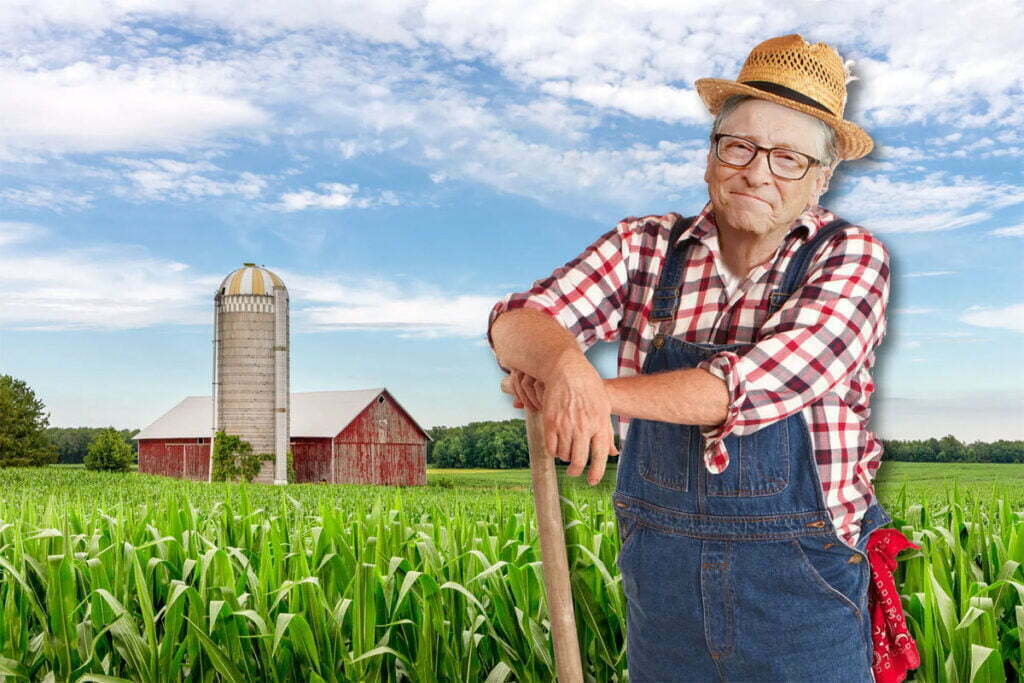
<p class="wp-block-paragraph">Even if you didn’t drop out of Harvard and start a monolithic tech company you can still benefit from the advice and investing habits of its founder, Bill Gates. Like his friend Warren Buffet, Gates eschews cryptocurrency, NFTs, Web 3.0, and the like. </p>


<p class="wp-block-paragraph">In case you didn’t know, Bill Gates is a technology pioneer. Gates co-founded Microsoft. Gates is a renowned software developer, international philanthropist, noted business magnate, and investor. ;He is also the ;fourth richest man ;on planet Earth with a net worth of $125 billion. So you ask yourself, what does this guy know that I don’t? Well, if you said agriculture, more specifically farming, you would be correct. ;</p>


<p class="wp-block-paragraph">Gates is hardly alone in the agricultural community, with over two million individual farms in the United States. The average size of a farm is 444 acres and the typical family owned farm makes on average about $69,000 in profits a year. Hardly seems like the kind of foray a billionaire would get involved in. </p>


<p class="wp-block-paragraph">Especially in these times, with tariff wars, international political tensions, climate change, and changing consumer demand putting even more pressure on the bottom line. As such, the government has stepped in to subsidize a staggering 40% of farmer income to the tune of tens of billions of dollars. </p>


<p class="wp-block-paragraph">Perhaps this is the ultimate contrarian bet by those with money looking for a bottom. Ninety-seven percent of American farms are family owned, with the remainder being corporate or co-opted. ;</p>


<figure class="wp-block-image"><img src="https://lh6.googleusercontent.com/QYx5U5NLZhcE4B_wkxU3c_XQJUDWYNds7XFzGHCJpbiLw1bjtD2WzeEIfRCbILvDBhhFM356YGYcJknLtchubh2ZkTddwhT8n9LoayIjc_I7yk9ur6z9Tms6jyBzq9f5UjLGt8hDq3K4GsRRqAINWA" alt=""/></figure>


<p class="wp-block-paragraph">Like any commodity or asset class, farmland is driven by supply and demand economics, and the amount of farmable land in the United States has been decreasing. Owning farmland is currently in vogue for the wealthy, seeking to benefit from climate change and to supply products to a hungry world with changing tastes. </p>


<p class="wp-block-paragraph">Gates is stepping in to use farmland to make Agri-Tech and financial investments. Gates is no neophyte to farmland investment as his portfolio looked to diversify from his significant stake in Microsoft back in the 90s. For the last 25 years, Michael Larson, a former Putnam bond fund manager, has managed the Gates’ personal portfolio as well as the considerable holdings of the Bill &; Melinda Gates Foundation. ;</p>


<p class="wp-block-paragraph">It was with Larson and his Cascade Investment LLC that Gates began his march into the world of farmland. Gates has more than doubled his acreage since then, now owning more farmland than anyone in America.</p>


<figure class="wp-block-image"><img src="https://lh6.googleusercontent.com/AK8ZOPMg2F3N6_3S2ZnXdz1Ue61yRjP1AsT53ketGmoSCVjD8spYLCOccf-P02CCxoz0xv9Z5SOJK8p4712_KsWNMs0vRTpTGDoM22ep91J8c44ZVbFwYBRMuP9TxRpDjvG7wFkNsd6AdfXF97TKbA" alt=""/></figure>


<p class="wp-block-paragraph">There are a myriad of speculative reasons why Gates would invest in farmland, but if you’ve read this column before, you’ll know it’s likely about the money. If you want to diversify away from the volatility of the stock market, what better and more negatively correlated asset class is there than farmland? </p>


<p class="wp-block-paragraph">One would also speculate that Gates plans to use his tech prowess to make advancements in agriculture. Such investments in farming may precipitate ;future advancements ;in Agri-Tech and traditional farming practices, i.e. seed technologies, super-crops, and overall farming efficiencies. The timing of Gates’ recent Ag investments coincidentally aligns with the rise of inflation. </p>


<p class="wp-block-paragraph">No investment has a perfect correlation with inflation, but farmland has a 70 percent correlation with the Consumer Price Index (CPI) and a 79.84 percent correlation with the Producer Price Index (PPI). Agriculture is considered our most important industry, and when inflation increases the price of food and farmland becomes even more valuable. People always need to eat.</p>


<figure class="wp-block-image"><img src="https://lh5.googleusercontent.com/QUlJzsROv7tuV0M8m_8HI6Yh7jpGXwuAEBQdnSptcT7bbIbVIhh9lBMiUc8bdIhlaIDf4Bees_lA1yYkwglvz0xpXSEoTlSysU3p6lFN6nKZycJT6yGr6ooDL_48Im5X6pD2_KUDJgIBf5bLDEOMBA" alt="https://thinkrealty.com/wp-content/uploads/2020/09/chart2.jpg"/></figure>


<p class="wp-block-paragraph">So how has farmland actually performed as an asset class over history? According to fool.com, “Over the last 50 years, the value of American farmland has risen by about 6.1 percent per year, with only five down years during that period.” According to the USDA, since 1991, farmland has produced a positive return every year, generating an average annual return of 11.5 percent, ;outperforming all other asset classes except the Dow Jones REIT Index during that time frame.</p>


<p class="wp-block-paragraph">As you might imagine, not everyone is enthralled with Gates and his control of such a large amount of U.S. farmland. Everything from conspiracy theories about the Chinese to his lack of knowledge of farming has all come to light with his most recent farmland purchase in North Dakota. One farmer in Georgia is particularly concerned with Gates. </p>


<p class="wp-block-paragraph">Will Harris, the owner of White Oak Pastures, a six-generation 152-year-old family farm in Bluffton, Georgia, says, “Gates is heavily invested in plant-based protein. He does not understand that proper animal impact is not responsible for climate change.”</p>


<p class="wp-block-paragraph">If you don’t happen to be the fourth richest person in the world and still would like to get a piece of the farmland action, you can do it by either buying a farm, which is expensive or investing in one of the two publically traded REIT’s, Farmland Partners (NYSE: FPI) and Gladstone Land Corporation (NASDAQ: LAND). </p>


<p class="wp-block-paragraph">Farmland will diversify your portfolio because it has a little-to-no correlation to the performance of other asset classes, and is an inflation hedge that combines low volatility, income, and proven long-term appreciation. ;</p>

Bill Gates is buying Farms. Should you?