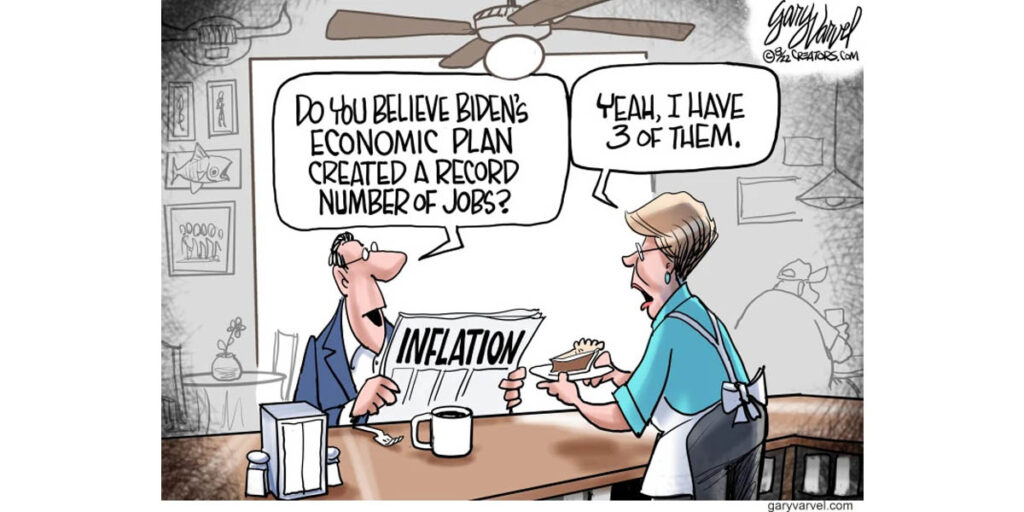
<p class="wp-block-paragraph">In a previous commentary, I have explained why Biden’s “great economy” is not so good for the average citizen. ; There is one issue that is less appreciated and rarely covered in the news media. ; It is the nature of those new jobs for which Briden takes credit.</p>


<p class="wp-block-paragraph">Overall, job creation under Biden has been sluggish despite his protestations to the contrary. ; Virtually all the jobs he claims to have “created” were simply jobs that returned as the Pandemic ended. ; In the three-plus years since the end of the Pandemic and the inauguration of President Biden, we have yet to achieve the number of workers that we had prior to the Pandemic. ;</p>


<p class="wp-block-paragraph">In February of 2020 – the start of the Pandemic &#8212; 159 million Americans were employed out of a population of 260 million eligible workers – 61 percent of eligible workers. ; While the number of eligible workers has increased by more than one million, the number of workers has yet to reach pre-Pandemic levels. ; We currently have 152 million workers – or 58 percent of eligible workers. That means we have seven million fewer workers than we did in 2020 &#8212; and a two point drop in the percentage of eligible workers. ;</p>


<p class="wp-block-paragraph">So far, Biden has not created any NEW jobs in the traditional sense. ; The jobs increases that Biden brags about are nothing more than businesses simply re-filling the jobs that were eliminated by the Pandemic shutdowns.</p>


<p class="wp-block-paragraph">But if you get into the weeks, the jobs situation is not even as good as the job reports may suggest – or as Team Biden spins them. ; A lot of the jobs are government workers – or jobs subsidized by government funds. ; They are not private sector jobs that are the result of consumer demand.</p>


<p class="wp-block-paragraph">Unless you are an acolyte of the Big Brother/Keynesian economy, you are more than a little wary of the economic and political meaning of huge growth in government jobs and government-subsidized jobs.</p>


<p class="wp-block-paragraph">The government added an average of more than 57,000 jobs per month in 2023. ; For some reason that does not include jobs in education – as if public school teachers are not government employees. Despite the Pandemic’s negative impact on the private sector economy, government employment increased significantly. ; In fact, it reached a record high in 2023 of 22,490,000 workers – and is expected to surpass the 24,000,000 mark in 2024.</p>


<p class="wp-block-paragraph">That also does not count government-subsidized jobs – as is the case with the Biden Infrastructure Bill, which spends $1.2 trillion on public works construction projects over the next years – or $240 billion per year. ; The misnamed Inflation Reduction Act spends another $891 billion over ten years – or $89 billion per year.</p>


<p class="wp-block-paragraph">Of course, we need government workers – and we do need government to use private sector contractors to a degree. ; And that is the eternal philosophic debate. ; How many government workers do we really NEED? ; And what is the appropriate level of private sector contracting? ; One thing we should all be able to agree upon is that we have already exceeded the appropriate levels of government employment and subsidies. ; We need to cut government spending – especially at the federal level.</p>


<p class="wp-block-paragraph"><strong>Public Sector Jobs v. Private Sector Jobs</strong></p>


<p class="wp-block-paragraph">So &#8230; what is so bad about creating public sector jobs – or funding private sector contractors to work on government projects—as opposed to jobs in the private sector. Simply put, just about everything. ; ; But to be specific:</p>


<ol class="wp-block-list">
<li>Increases in government jobs – and government subsidies of the private sector – require government spending, and that means either increasing taxes, printing more money (inflation) or more borrowing. ; It increases budget deficits that increase the National Debt.</li>
</ol>


<p class="wp-block-paragraph">To put that into historical perspective, the National Debt in 1980 was 52 percent of the GNP. ; Twenty years later, in 2000, it was 57 percent – a five percent increase in twenty years. ; It has almost doubled in the past 20-plus years. ; And it is on track to keep increasing relative to the GNP. ; That means economic disaster unless we take drastic action immediately to change the trend to a declining trajectory.</p>


<ul class="wp-block-list">
<li>Government spending is by far the least efficient, less productive, more wasteful and most costly when compared to private sector spending. ; It is basically the lack of supervision of spending. ; Without competition and the need to address profits, there is an incentive to apply fiscal responsibility. ; The Washington political and bureaucratic operates on the benefits of spending without sufficient concern as to the source of the money.</li>
</ul>


<ul class="wp-block-list">
<li>Government spending is not based on consumer demand – people influencing demand &#8212; but on the arbitrary decision of government officials. ; Example: Solyndra. ; That company was given more than $500 million in loan guarantees by the Obama administration to develop solar energy technology that had no consumer market at the time. ; The company went bankrupt and Uncle Sam lost everything but $24 million from the selling off of company assets. You are seeing the same thing in terms of electric vehicles.</li>
</ul>


<ul class="wp-block-list">
<li>Government spending is used to maintain constituent political loyalty through perceived benefits for competing interest groups. They are too often designed to win voter support than provide essential needs. In other words, politics trumps needs in the decision-making process.</li>
</ul>


<ul class="wp-block-list">
<li>Government jobs tend to be permanent. ; They are not responsive to changing economic conditions. Rather they exist based on rigid rules, (union) contracts, tenure and political considerations.</li>
</ul>


<ul class="wp-block-list">
<li>Government requires contractors to be unionized – needlessly increasing the cost to taxpayers. ; It is basically compulsory unionism.</li>
</ul>


<ul class="wp-block-list">
<li>Government employment and contracting often drives the more economically more beneficial private sector out of the market.</li>
</ul>


<ul class="wp-block-list">
<li>It expands the power and authoritarianism of the central government – making the will of an elitist government establishment dominant over the will of the people.</li>
</ul>


<p class="wp-block-paragraph">Biden’s bragging about all those jobs he claims he has “created” is just another example of the adage that “figures do not lie, but liars figure.”</p>


<p class="wp-block-paragraph">So, there ‘tis.</p>

Biden is not “creating” jobs … and the numbers prove it