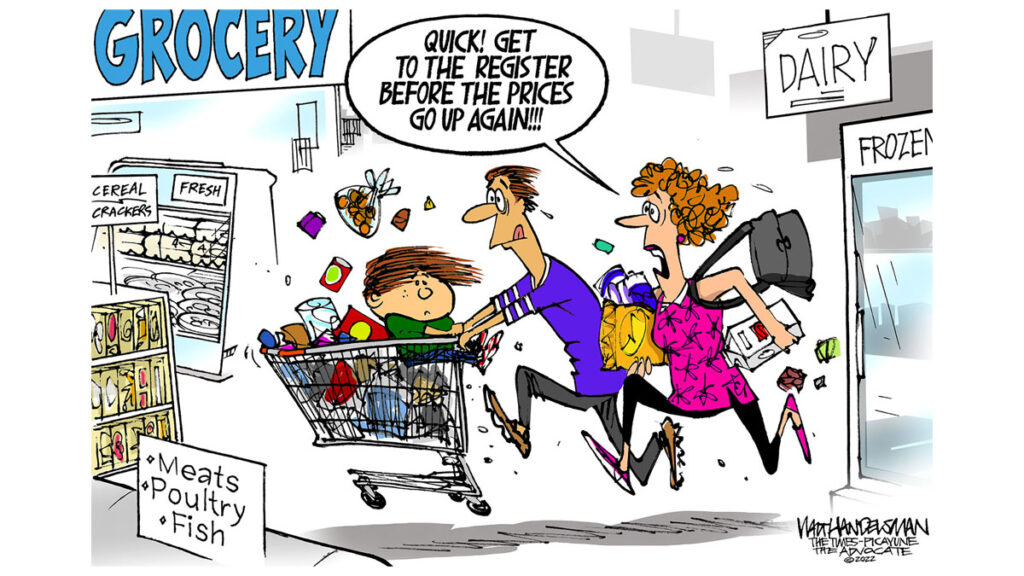
<p class="wp-block-paragraph">We are hearing a lot about affordability as if it is a new issue. Actually, it is an evergreen political issue most notably advanced by Democrat strategist James Carville when he said, “It’s the economy, stupid.”</p>


<p class="wp-block-paragraph">As long as I can recall, the number one issue in politics has been the economy – the cost of living as perceived by the people. When the economy is going strong and the folks around the kitchen table are happy, other issues may come to the fore in political platforms and campaigns. But … one little hiccup in the economy and it becomes the number one issue on the minds of voters as they head to the polls.</p>


<p class="wp-block-paragraph">We saw that in 2024. The Biden economy was not good in the minds of the American people – no matter what Democrats were saying. Distrust of Biden’s handling of the economy was the major factor that led voters to ignore the “hateâTrumpâatâallâcosts” strategy employed by the Democrats is what returned “The Donald” to the White House.</p>


<p class="wp-block-paragraph"><strong>The History of Economics as THE Issue</strong></p>


<p class="wp-block-paragraph">The economy has been the decisive factor in elections since the founding of the Republic. In fact, the Panic of 1837 – a financial crisis marked by bank failures and unemployment – destroyed Martin Van Buren’s presidency. He inherited the downturn from Andrew Jackson’s policies, but voters punished him nonetheless.</p>


<p class="wp-block-paragraph">Fast forward to the Great Depression of the 1930s. Herbert Hoover and Republicans were swept out of office in 1932 as Franklin Roosevelt promised a “New Deal” to restore prosperity.  ;Roosevelt’s ability to project optimism on the economy got him elected for an unprecedented four terms.</p>


<p class="wp-block-paragraph">Even in more modern times, recessions and recoveries have determined political fortunes. Jimmy Carter’s presidency was crippled by stagflation – the toxic combination of high inflation and high unemployment. Ronald Reagan’s famous line, “Are you better off than you were four years ago?” was all about the economy and resonated with voters who felt that they were not better off. Reagan won re-election in a landslide in 1984 by ending the Carter inflation.</p>


<p class="wp-block-paragraph">Then there was the Eisenhower era of “Peace and Prosperity.” The 1950s were marked by steady growth, rising wages, and relative calm abroad. Eisenhower’s popularity was rooted in the perception that he presided over a stable, prosperous America. Voters rewarded him with two terms, and the phrase “peace and prosperity” became shorthand for the political advantage of a strong economy.</p>


<p class="wp-block-paragraph">The lesson is clear. ; When the economy is good, incumbents thrive. When it falters, they fall.</p>


<p class="wp-block-paragraph"><strong>Today</strong></p>


<p class="wp-block-paragraph">That brings us to the present moment. There are always multiple issues, but the 2026 midterm elections are likely to be decided on the economy. At this point, the advantage goes to the Democrats according to polls. Inflation has moderated compared to the spikes of the early 2020s, wages are rising modestly, and unemployment remains low. While Republicans continue to hammer on immigration and cultural issues, Democrats have wisely shifted their message. They are no longer relying on fearmongering about Trump or demonizing Republicans. Instead, they are talking about affordability – the cost of groceries, rent, healthcare, and gas.</p>


<p class="wp-block-paragraph">It is a smart pivot. In politics, you win by addressing what voters feel most acutely. And right now, voters feel the pinch of everyday expenses. Democrats are framing themselves as the party that understands the kitchenâtable concerns of ordinary families – the turf Republicans held in 2024.</p>


<p class="wp-block-paragraph">Polls show Democratic House and Senate candidates gaining ground by emphasizing affordability – promising to lower prescription drug prices and expand tax credits for working families. Democrats are highlighting manufacturing jobs and costâofâliving relief. ; This resonates with voters in states where auto workers recently fought for higher wages.</p>


<p class="wp-block-paragraph">The emphasis on kitchen table issues is credited with socialist Zohran Mamdani’s victory in New York City’s mayoral contest. ; These are not abstract issues. They are tangible, immediate, and personal.</p>


<p class="wp-block-paragraph">Republicans, meanwhile, risk repeating the Democrats’ mistake of 2024 – focusing too much on personalities and grievances rather than the pocketbook. Voters may dislike Trump’s style or Biden’s age, but when they step into the voting booth, they are thinking about their mortgage payments, their grocery bills, and their retirement savings.</p>


<p class="wp-block-paragraph">The Democrats’ rebranding of the economy as “affordability” is clever. It takes a perennial issue and gives it a fresh label. It allows them to talk about inflation without using the word, which still carries negative connotations. It lets them connect with voters who may not follow GDP numbers but know exactly how much eggs and milk cost at the supermarket.</p>


<p class="wp-block-paragraph">Of course, the advantage is not guaranteed. Economic perceptions can change quickly. A drop in gas prices, a record advances by the stock markets or drops in unemployment could shift the mood before November 2026.</p>


<p class="wp-block-paragraph">For now, Democrats have the upper hand. Based on history alone, they are likely to take control of the House. ; They have learned that voters care less about partisan vendettas and more about whether they can afford both healthcare and food. By focusing on affordability, they are speaking the language of the people. And in American politics, that has always been the winning language. “Affordability” is not a new concept, just a new label.</p>


<p class="wp-block-paragraph">So, there ‘tis.</p>

“Affordability” — A New Label on an Old Product