

















Cutting Down the Federal Government is a Good Thing … Period
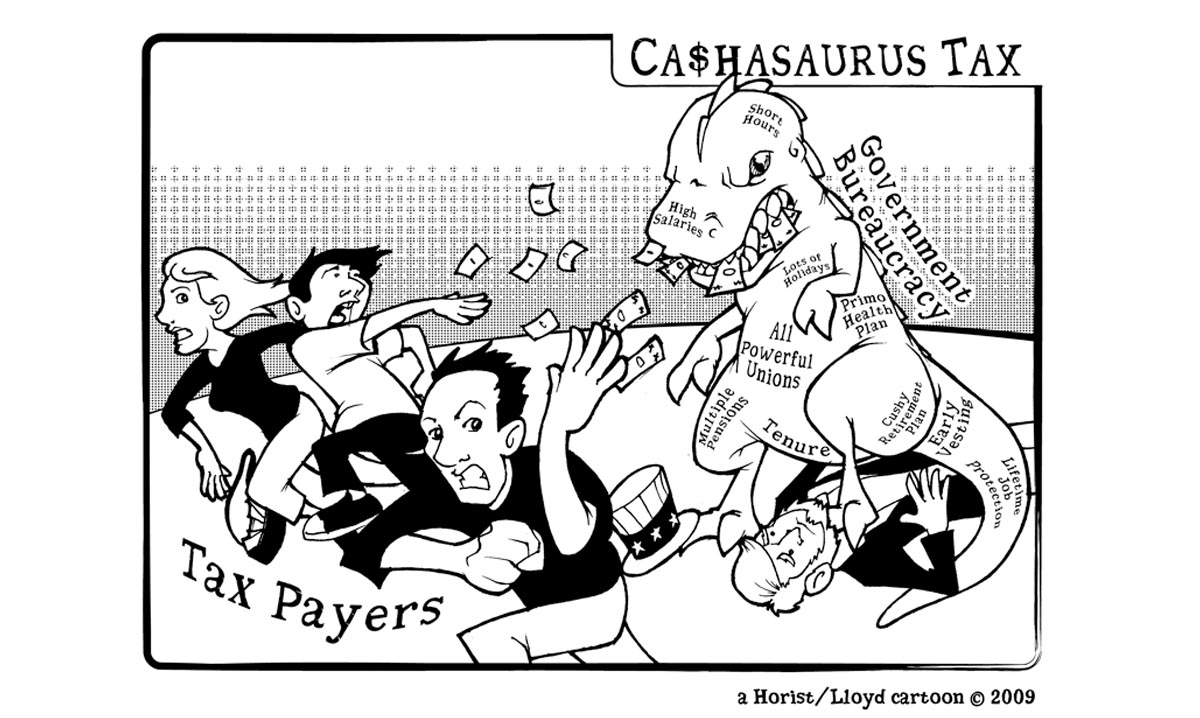
I am among those (conservatives) who believe that our federal government is too big and too expensive – bloated with waste and corruption. In the past century, Uncle Sam has assumed too many regulatory powers that are best handled by states and municipalities – as the Constitution requires.
The federal system was the genius of the Founders – and we are losing it to an increasingly oppressive and powerful central government run by an unelected and accountable permanent elitist class. Just what the Founders feared most.
Therefore … any time we have an opportunity to reduce the size of the burgeoning federal bureaucracy, we should take it. Any time we can cut federal taxes, eliminate programs and reduce the number of bureaucrats, we should do it.
Of course, the Democrats – the party of big tax-spend-and-regulate government – will do a lot of caterwauling. They will declare that every bureaucrat and every program is existential to the security and well-being of every American. That is just propaganda and political hyperbole. (And Republicans in Washington are not much better.)
The United States was founded on the principle of limited government, with a clear division of powers between the federal and state governments. (Read the Tenth Amendment). Yet over the past 75 years or so, the federal government has expanded far beyond its constitutional boundaries. This unchecked growth has led to staggering fiscal consequences, a bloated bureaucracy, and a dangerous erosion of state sovereignty. The numbers are not just alarming — they are existential.
This means that more and more programs and functions are being assumed by the most distant, the least responsive, most inefficient, most wasteful, least supervised, and most irresponsible government.
Let us begin with the raw data. In fiscal year 2025, federal spending reached $7 trillion, up from $6.29 trillion the previous year. Compare that to $332 billion in 1975 and a mere $42.6 billion in 1950. That’s a 16,000% increase over 75 years. Even adjusted for inflation and GDP growth, the federal government’s footprint has exploded, especially in non-defense areas like education, healthcare, and welfare.
The national debt tells an equally grim story. In 1950, it stood at $257 billion. By 1975, it had grown to $533 billion. Today, it exceeds $34 trillion — a 130-fold increase since 1975. Interest payments alone are projected to surpass defense spending within a few years. This is not just unsustainable — it is insanely reckless.
Meanwhile, the federal workforce continues to swell. In 1950, there were about 1 million non-military federal employees. By 1975, that number had nearly doubled to 1.9 million. Today, it stands at 2.3 million, excluding the Postal Service. Despite advances in automation and digital services, Washington continues to hire more and more people.
Much of this growth stems from a fundamental ideological shift. The left-wing establishment in Washington has increasingly centralized power — assuming managerial control (or funding) programs and services that were once the domain of states. This federal overreach undermines local autonomy, stifles innovation, and creates one-size-fits-all policies that fail to address the unique needs of diverse communities.
Consider education. The Department of Education (DOE), created in 1979, now commands a budget of more $80 billion annually. Yet education is a local issue. Ironically, American education outcomes were demonstrably better before Washington took hold. In fact, education quality and results have steadily declined since the establishment of the DOE
Another example is the Environmental Protection Agency (EPA), which regulates everything from carbon emissions to puddles on private property. While environmental protection is important, many of the EPA’s rules are duplicative of state efforts or so sweeping that they hinder economic development. States like Texas and Florida have robust environmental agencies capable of managing local concerns without federal interference.
Then there are the truly absurd programs. The federal government has funded studies on romantic relationships among fruit flies, spent millions on clown school in Argentina, and supported a National Institute of Health project examining the effects of cocaine on quails’ sexual behavior. We later learned that Uncle Sam helped fund gain-of-function research in Wuhan China – a likely cause of the worldwide Covid-19 pandemic. These are not isolated incidents. They reflect a culture of waste and a lack of accountability in federal spending.
Even infrastructure, once a shared responsibility, has become a battleground for federal control. The Department of Transportation oversees grants and regulations that often delay projects and inflate costs. States are perfectly capable of managing their own roads, bridges, and transit systems without federal money and micromanagement.
The consequences of this federal sprawl are profound. It leads to inefficiency, duplication, and waste. It erodes the constitutional balance of power. And it disconnects government from the people it serves. When decisions are made in Washington rather than in state capitals, they are beyond the influence of the people back home.
The latest example of fiscal irresponsibility came in September 2025, when Democrats demanded a vote on more goodies to reopen the government — a move that would have add an astounding $1.5 trillion to the National Debt at a time when cutting the National Debt is the only rational option. The proposal included permanent extensions of enhanced ACA subsidies, expanded Medicaid funding, and taxpayer-funded benefits for illegal immigrants. Republicans called it a “ransom note to taxpayers,” packed with partisan priorities and reckless spending.
This is not just bad policy — it is generational theft. The current tax-and-spend policies championed by Democrats are mortgaging the future of our children and grandchildren. Every dollar borrowed today is a dollar they will have to repay — with interest. If left unchecked, the risks includes currency devaluation, interest rate spikes, economic stagnation and collapse of entitlement programs. If you think we have dealt Gen Z a bad hand, just wait to see what we have left their kids and grandkids.
Reducing the size and cost of the federal government is not just a good idea — it is a survival imperative. That means returning power to the states, eliminating redundant agencies slashing wasteful spending and imposing strict budget caps.
Some steps are already being proposed. The Department of Government Efficiency has cut billions from the federal budget. These are bold moves. They reflect the urgency of the moment – but still not nearly enough. And their mission has been aborted.
Ultimately, the path forward requires political will and public support – and a measure of a sacrifice. Americans must demand a government that is lean, efficient, and constitutionally grounded. We must reject the notion that Washington knows best and embrace the wisdom of local governance – where we the people have the most influence. The stakes are high. But there is an opportunity to restore balance, accountability, and fiscal sanity to our Republic we are willing to take it.
As of this writing, Trump has essentially fired 4100 bureaucrats. One can only hope that this just the beginning. The federal budget needs major surgery – and Democrats are only interested in cosmetic surgery – if even that — while they continue their long corrosive history of reckless spending.
The Constitution envisioned a limited federal government. It’s time we honored that vision — before it’s too late.
So, there ‘tis.




Larry claims: “Of course, the Democrats – the party of big tax-spend-and-regulate government.” Nice to see he’s updating his old gem adding “regulate. Turd-polishing 101 and his normal oversimplification of a complex issue.
OK, stop the boat, stop the boat right there. Fucking Hegseth that boat and any survivors. Larry is an economics major, claims he does work in that field, pitched Reagan’s economy for Reagan, I think. He should know better. He should update his shtick. What he claims still is relevant today may have been true when he worked for Tricky Dick’s illegal empire, but today? NOT BLOODLY LIKELY. And he has just got to know it. He just can’t be that old of mind.
Let’s do a little walk down deficit row on debtor’s streety. I will start at 1913: When inflation adjusted, Republican presidents added slightly more to the national debt per four-year term, averaging approximately $1.4 trillion compared to $1.2 trillion for Democratic presidents. PERIOD.
Due to serving more years in office over the same period (nine additional years), Democratic presidents have added a bit more total inflation-adjusted debt in TOTAL ACCUMULATION: $18T vs. $17.3T for Republicans. If serving equal terms, Republicans would rule that one too.
Let’s get really recent. Trump 1.0 added about $7.1T to the national debt, a record for either party. Tax cuts without spending cuts caused a lot of this.
Obama added $5.6 trillion per term during The Great Recession started on Republican’s watch.
Biden added about $2.8T through late 2024, that piker. Unlike Trump, Biden passed huge spending bills like the ARA, but others like the IRA, had deficit-reduction provisions.
Bottom line: every Democratic president since Kenndy has left office with a lower annual deficit than they inherited. Joe’s first three years confirms that, his fourth year a bit higher, and Trump amazingly came in a tad less than Biden’s fourth year where I indicated Biden jumped up a bit. Most analyst’s are calling it a tie making Trump’s first year deficit the highest in four years, but tying Biden’s fourth. Trump’s deficit in 2025 is over two times the pre-pandemic deficits from 2013 to 2019. Yeah, twice as bad.
The only budget surplus in modern history was under Bill Clinton, a Democrat.
Not busted, but seemingly outdated and confused. I spell my name: danger. And frank facts be our friends, yet sometimes, to some people, a danger. You can often tell in how they respond.
Dunger have you ever been a cuckold? You mentioned a wife. Are you keeping the home fires burning? My grandmother used to say that women are harder to hold when the big man comes along.
Williesucksdung: so sorry to hear about your grandmother’s wanton promiscuous nature based not on character but physical attributes. If she calls you, “her little man,” uh oh 🙂
If you are demeaning my wife, proudly gfy, for lowering the ad hominem bar to third-party attacks on women. Shaming a guy’s wife is really low.
And yes, I do keep the home fires burning, literally, heating most of the time with renewable wood pellets at a most clean and healthy efficiency level. About six tons a year.
This year I added an inverter technology heat pump split for low energy, high efficiency turbo boost for the great room. I am impressed.
I do feel a little guilty about being at 75 and tend to get warmer the colder it gets as I bring more stoves online. But as I reduced my oil to noise, my pollution to a fraction, and my bills by a third, why not be old-man warm?
Here’s hoping you get what you deserve for Christmas. Twice.
” I spell my name: danger. And frank facts be our friends, yet sometimes, to some people, a danger. You can often tell in how they respond.” (see Willieatsdung above discuss my life, my personal life for his prurient pleasure.)
In modern times, GOP administrations frequently enact large-scale tax cuts that reduce federal revenue, alongside increases in military spending, but they cut little spending. TRUMP SPENT MORE IN 2025 THAN ANY OTHER PRESIDENT IN HISTORY: period. He did this while returning one quarter of negative GDP growth seemingly failing on both spending and revenues.
In modern times, Democratic administrations are often linked to increased social spending and economic stimulus programs, particularly during recessions, but they are more likely to, at least, reduce the increase in the deficit as Joe did three out of four years. It’s a start, it’s prudent management, but IMO, we still need more. A lot more of less. That does not mean we need to not spend; we just need to spend wisely making each decision have profit or true value.
The reality bottom line: you can’t just point fingers at the other guy, there is not a binary choice; we are all in this together, we did it together, we can only fix it together, and people know this: it will take DECADES, plural intended, to fix. Or do continue to do nothing and it will fix itself, and trust me, you don’t want to be there for that. Our economy, as a system, always moves to equilibrium, it’s perfect that way fixing itself. But while the system will correct, the pain that individuals will see may be immense depending on what we do. Like individual pain well beyond Great Recession, maybe beyond Great Depression immense, way beyond, potentially.
Horist points the finger at liberals being to blame and voting Republican is his cure. He is wrong. Success does not favor a win-lose strategy where 50% of the people are totally pissed depending on who is in the White House (even with gold trim). United we stand, divided we fall. We can disagree issue by issue on the economy, but in the end, only working together in compromise will move us forward in the most efficient, effective, and positive manner. As of today, we are failing under Trump 2.0.
Trump’s government is the smallest in 3 years, but still matches size with our government from 1998 to when Trump took office in 2017 to start the growing government syndrome all over again. Don’t see proof yet of massive reductions in spending or employees. His deficit speaks to the spending. On the employees, whenever we fire a USAID type, the ICE men cometh to take their place. And while you may feel ICE be nice, fact is ICE most expensive than USAID types. IMO, it’s OK to spend IF you get a great positive return on the buck. Not sure ICE is profitable in that regard. And if not, that’s what starts us circling the toilet bowl of deficit and debt. The guy who has been here ten years, no crimes, pays taxes, seems to be a profit to America, and we should figure out perhaps a compromise where we rid ourselves of criminals, beyond the misdemeanor of jumping the border and retain assets generating profit for all America. Just examples, not a political statement even.
I spell my name: danger. Still.
Larry, Of course the numbers that Frank quotes are correct, but you will never admit that. We do have a problem with the annual budget deficit, which of course leads to long-term growth of the public debt, but the numbers that you quote are not the cause of this. The issue is-Conservatives have demanded tax cuts every time they have held the Presidency in the last 45 years, it is not that we have been spending so much, instead we have been taking in too little. Recall that the budget for the DoD that was recently passed is just shy of a trillion dollars by itself, makes that $30 billion you mention look pretty insignificant (which it is). Of course there is some waste in government programs (as there is in state programs and private industry). The answer to this is not the indiscriminate chopping of departments by ignorant people who know nothing about the jobs that these departments have-getting rid of USAID was perhaps one of the worst decisions made by the idiot Musk and his doge boys, but there were so many instances it is hard to pick which ones. Budgets for the IRS were increased during the Biden term, and of course everyone loves to hate the IRS, but that money was to hire more inspectors, and collect more money from the wealthy tax cheats-of course the billionaires in the current regime didn’t want that to happen, so the IRS budget was cut. Bottom line Larry, you have written another batch of drivel (which is usually the case), showing that you don’t really give a damn about the country as a whole, and buy into the bullshit that Republicans have been spouting since God was a young child, which has done nothing but drive the wealth of the rich vs poor further apart….
Danger and Mike F – rather than continuing your incessant name calling and personal attacks, what ideas do you have to reduce our deficits? C’mon let’s hear em. I personally do not think the American taxpayer would mind paying a little bit more in taxes as long as there were commensurate reductions in spending – especially on programs only helping the 50% of the people who are non-taxpayers. Every American should be asked to share equally in the fiscal pain required to solve the deficit issue.
Don; beyond returning volume and picking on public figures who name call, you show me where I do what you fantasize about.
I have talked a lot about ideas and concepts to reduce deficit and debt, but let me sum this most difficult math for you: targeted raised taxes and, at this point, flat % spending reductions.
The answer is not going to just come from cuts as Mike F clearly stated.
Ta da!!!!
Trump is already doing it, but illegally and half assed. He is also grifting using the Presidency to even sell cheesy watches that don’t work. But making hundreds of millions off his crypto that anyone can bribe from him, I mean buy from him, legally. Need a pardon? Just buy a million in Trump crypto and you can push 400,000,000 tons of coke and go free.
Trump Tariffs are nothing but taxation without representation, a higher tax. He also claims he’s spending less, but he’s spending more. He spent the most of any President, although he tied Biden’s last year.
Seriously though: I have pitched tax the rich, proven we tax them at historically low rates today. I have pitched balanced budget, measured and timed, not a Constitutional amendment. Means testing a lot vs Trump’s new meanie-testing to illegally tax our Social Security. Budget cuts – start with defense. Many more already pitched here
Hope that helps. But I doubt it will soothe your savage beast.